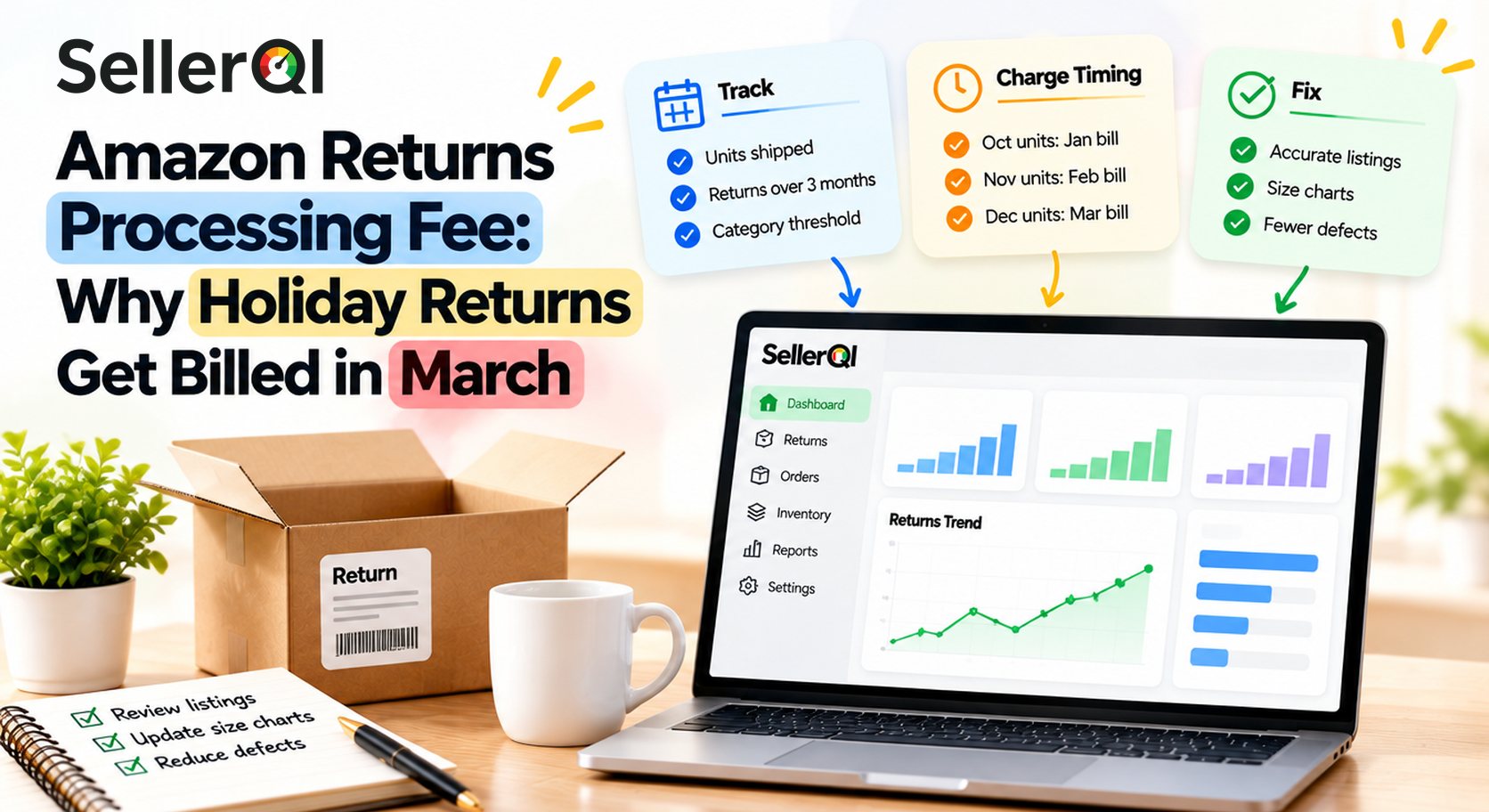
The Amazon returns processing fee is a per-unit FBA charge for products whose return rate goes above their category threshold. Amazon counts returns of units shipped in one month over that month and the next two, then bills the fee between the 7th and 15th of the third month after. So December holiday returns get billed in March.
Most sellers only notice this fee when it shows up in a settlement report. By then the returns have already happened and the charge is already made. This guide explains how the fee works, why the holiday season is when it hurts most, what changes in 2027, and a step-by-step way to check every ASIN before the bill arrives.
Key takeaways
- The fee only applies to returned units above your category's return rate threshold, not every return.
- Formula: units over threshold = returned units − (units shipped × category threshold). Multiply by your per-unit fee.
- Units shipped in December are tracked through February and charged between March 7 and 15.
- ASINs that ship fewer than 25 units in a month are exempt for that month.
- Amazon's 2027 fee update moves the returns fee onto the new 2027 size tiers, so re-check your per-unit cost in January and February.
What Is the Amazon Returns Processing Fee?
The Amazon returns processing fee is a charge Amazon adds for each customer-returned FBA unit above a set return rate for the product's category. Amazon introduced the current version on June 1, 2024 for products with high return rates in all categories except apparel and shoes, which run under their own returns fee rules.
A few terms you will see in this guide:
- Return rate: returned units divided by units shipped for the same shipment month.
- Return rate threshold: the maximum return rate Amazon allows for a fee category before the fee starts.
- Units over threshold: the returned units above that allowance. These are the only units that get charged.
- Return Insights: the dashboard on the FBA Returns page in Seller Central that shows your return rate, your threshold and the units being charged.
Amazon's own announcement says the fee applies "to each returned unit above the threshold," and only to physically returned units. Amazon staff have also stated on the Seller Forums that returns caused by Amazon's own errors are not counted. You can read the original post in Amazon's Return Insights and returns processing fee announcement.
How Does Amazon Calculate the Returns Processing Fee?
Amazon calculates the fee per ASIN, per shipment month, in four steps:
- Count units shipped to customers in a calendar month.
- Track returns of those units during that month and the following two calendar months.
- Compare the return rate with the threshold for the product's fee category.
- Charge the fee on each returned unit above the threshold, between the 7th and 15th of the third month after the shipment month.
Two exemptions matter. If an ASIN ships fewer than 25 units in a month, returns from that month are not charged. And for products in Amazon's New Selection program, Amazon waives the fee for the first 20 returned units that go over the threshold.
What Are the Return Rate Thresholds by Category?
Thresholds vary by category, and Amazon publishes the full table on its Returns processing fee help page. The ends of the range give a sense of scale:
| Fee category | Return rate threshold (2026 table) | What it means |
|---|---|---|
| Grocery and Gourmet | 2.9% | The strictest category. Three returns per 100 units can already trigger the fee. |
| "Everything else" (default) | 4.8% | Applies to products that do not fall into a named fee category. |
| Backpacks, Handbags and Luggage | 12.8% | The most lenient category in the 2026 table. |
Thresholds for other categories sit between these two points. Always confirm the exact threshold for your ASIN in the Return Insights dashboard, because that is the number Amazon uses for your charge.
How Much Is the Fee per Unit?
The per-unit fee depends on the product's size tier and shipping weight. Under the 2026 rate card it starts at about $1.78 for the lightest small standard-size items and rises to around $5.00 for a 3 lb large standard-size item, with bulky items costing more. Check your own rate in Seller Central rather than estimating, because the 2027 update changes the size tiers.
Why the Holiday Season Creates a Returns Fee Spike
The holiday season stacks three things against you: high volume, gift returns, and a long return window. Amazon's holiday policy for 2026 lets most items bought between November 1 and December 31 be returned until January 31, 2027 (Apple products until January 15). Amazon has told sellers this policy now applies every year in its Seller Central holiday returns announcement.
Gifts that are the wrong size, wrong color or simply unwanted all come back in January. Because the fee looks at returns of units shipped in a given month, your November and December shipment months can carry a much higher return rate than your normal months. Here is when each holiday month gets billed:
| Units shipped in | Returns counted through | Fee charged | What to check now |
|---|---|---|---|
| October 2026 | December 2026 | January 7 to 15, 2027 | Early Prime Day and pre-holiday returns |
| November 2026 | January 2027 | February 7 to 15, 2027 | Black Friday and Cyber Monday units |
| December 2026 | February 2027 | March 7 to 15, 2027 | Gift returns from the extended window |
The time lag is the trap. A seller looking at January profit sees strong December sales and moves on. The cost of those sales keeps arriving in February and March as refunds, unsellable returns and returns processing fees.
A Worked Example
Say an ASIN in the "everything else" category (4.8% threshold) ships 1,000 units in December. Holiday gift returns push 72 of those units back by the end of February, a 7.2% return rate.
- Allowed returns: 1,000 × 4.8% = 48 units
- Units over threshold: 72 − 48 = 24 units
- Fee at an illustrative $3.00 per unit: 24 × $3.00 = $72
$72 does not sound like much. But the fee is only the visible part of the cost. Those 72 returns also mean refunded revenue, possibly unsellable units, and lost ranking signals while the return rate is high. Multiply that across 30 ASINs and three holiday months, and the returns line can wipe out a large share of the Q4 profit you thought you made. This is the same pattern we cover in our guide to FBA fees and hidden costs.
What Changes for the Returns Processing Fee in 2027?
Amazon announced its 2027 US fee changes in early November 2026. FBA fulfillment fees will rise by an average of $0.19 per unit sold, about 0.8% of the average selling price, with most changes starting January 15, 2027. Details are in Amazon's 2027 fee announcement.
For returns, summaries of the announcement say the returns processing fee will be updated to match the new 2027 size tiers, starting January 15, 2027 for apparel and shoes and February 1, 2027 for other high-return categories. Amazon had not published the new per-unit returns rates in public summaries at the time of writing, so check the fee table in Seller Central before you update your margin models.
Other February 1, 2027 changes affect the same holiday inventory:
- Storage: the storage utilization surcharge is removed, and the aged inventory surcharge is folded into a single age-based storage rate. Stock that sells within six months pays the same or less; aged stock pays more.
- Low-inventory-level fee: it will apply only when inventory falls below 28 days of supply, based on actual shipments in the four weeks before and after the check.
Returned holiday units that go back into sellable stock and then sit unsold are exactly the inventory that the new age-based storage rate charges more for. Returns and storage need to be watched together.
How to Check and Lower Your Amazon Returns Processing Fee: 7 Steps
Use this routine in December and again in January, while there is still time to fix the causes before the February and March charges.
- Open Return Insights. Go to the FBA Returns page in Seller Central. It shows each ASIN's returned units, return rate, the threshold for its fee category, and the units above the threshold that will be charged.
- Sort by distance to threshold. List every ASIN at or above about 80% of its threshold. These are the products where a few more returns tip you into the fee.
- Read the return reasons. Pull the FBA customer returns report for the flagged ASINs and group the reasons: "not as described," "wrong size," "defective," "no longer needed." Each reason points to a different fix.
- Fix the listing for "not as described" returns. Compare the title, bullets, images and A+ content against the real product. Add exact dimensions, what is in the box, and compatibility details. Our guide on listing images that convert covers how to show scale and contents clearly.
- Add sizing help for "wrong size" returns. Put a size chart in the images and in A+ content, and answer sizing questions in the bullets. Gift buyers guess more often, so make the guess easier.
- Escalate "defective" returns to your supplier. Check the customer comments and any unsellable units for a pattern, then fix packaging or quality at the source. A packaging fix often costs less than a single month of fees.
- Re-check profit after the charge posts. When the fee appears in your payments transaction view, match it to the ASIN and compare it against your margin. Products that keep crossing the threshold may need a price change, a listing rebuild or a decision to stop selling them.
Which Returns Signals Should You Monitor All Year?
Returns are not only a holiday problem. Track these metrics monthly so a rising return rate shows up before it becomes a fee, a "Frequently returned item" badge on your detail page, or an account health issue:
- Return rate by ASIN against its category threshold
- Top three return reasons per ASIN, and whether the mix is changing
- Unsellable return units and their cost
- Returns processing fees charged per ASIN in the payments report
- Net margin per ASIN after refunds and return fees
- Listing changes made around the time return rates rose
The last point matters more than it looks. A listing that was edited by a catalog update, or a variation that was merged with a different product, can start drawing the wrong buyers overnight. Regular listing audits catch these changes before the returns do.
How SellerQI Helps You Catch Return Costs Early
SellerQI connects to your Amazon account with read-only access and runs a diagnosis every 24 hours. Its profit dashboard nets refunds and return processing fees against revenue for every ASIN, so you can see which holiday bestsellers are actually making money once returns come in.
The Listing Health Scanner flags listing issues such as missing details, suppressed content and unexpected changes, which are common causes of "not as described" returns. SellerQI is free to connect, and if you want a second opinion on what the numbers mean, you can book a 30-minute call with the team.
Conclusion: Treat Holiday Returns as a Q1 Cost
The Amazon returns processing fee is small per unit but easy to miss because it arrives up to three months after the sale. Holiday gift returns, the January 31 return deadline and the 2027 size tier update all land in the same window. Check Return Insights now, fix the listings driving avoidable returns, and judge Q4 by its profit after returns, not by December revenue.
Frequently asked questions
What is the Amazon returns processing fee?
The Amazon returns processing fee is an FBA charge on customer-returned units above a product category's return rate threshold. Amazon measures returns of units shipped in a month over that month and the next two, then charges each returned unit above the threshold. Apparel and shoes follow separate returns fee rules.
Is the returns processing fee charged on every return?
No. For most categories, Amazon charges the fee only on returned units above the category's return rate threshold. If your threshold is 4.8% and you ship 1,000 units, the first 48 returns are not charged. Only physically returned units count, and Amazon says returns caused by its own errors are excluded.
When does Amazon charge the returns processing fee?
Amazon charges the fee between the 7th and 15th day of the third month after the shipment month. Units shipped in November 2026 are tracked through January 2027 and charged in February 2027. Units shipped in December 2026 are tracked through February 2027 and charged in March 2027.
Where can I see my Amazon return rate threshold?
Open the FBA Returns page in Seller Central and use the Return Insights dashboard. It shows returned units and return rates used for the fee, the minimum return rate threshold for each product's fee category, and the number of returned units above the threshold that will be charged.
Are low-volume products exempt from the returns processing fee?
Yes. If an ASIN ships fewer than 25 units in a calendar month, Amazon does not apply the returns processing fee to returns of units shipped that month. Products enrolled in the New Selection program also get the fee waived on their first 20 returned units above the threshold.
How do I reduce my Amazon return rate?
Start with return reasons in the FBA customer returns report. Fix "not as described" returns with accurate titles, images, dimensions and box contents. Add size charts for sizing returns, and take defect patterns to your supplier. Then track return rate by ASIN monthly so problems surface before they become fees.
Does the 2027 Amazon fee update change the returns processing fee?
Yes. According to summaries of Amazon's 2027 announcement, the returns processing fee moves onto the new 2027 size tiers from January 15, 2027 for apparel and shoes and from February 1, 2027 for other categories. Check Seller Central for the new per-unit rates before updating your margin calculations.