
TL;DR
Most sellers rely on an incomplete Amazon FBA fees breakdown, missing hidden costs like dimension errors, return overcharges, and lost inventory that quietly reduce profits.
Small fee inaccuracies, like incorrect product dimensions or weight, can push items into higher fee tiers and lead to thousands in yearly losses.
Amazon often does not automatically reimburse for lost, damaged, or incorrectly processed inventory, leaving sellers responsible for identifying and claiming these amounts.
Common hidden loss areas include return refund errors, shipment discrepancies, incorrect fee categories, long-term storage fees, and co-mingled inventory damage.
Manually auditing these issues is complex and time-consuming, requiring multiple reports, cross-checking data, and strict claim deadlines.
SellerQI automates this process by identifying reimbursement opportunities, providing claim-level data, and helping sellers recover money Amazon already owes them.
You check your Amazon dashboard; sales look good, and yet your profits tell a different story.
Ever noticed this happening?
The gap between what you think you're earning and what you actually keep comes down to one thing: the Amazon FBA fees breakdown most sellers never fully understand. Amazon charges fees across dozens of categories, many of them quietly, many of them incorrectly, and the majority of sellers have no idea how much is being taken.
This guide breaks down exactly where your money is going, which hidden FBA costs to watch for, and how to get back what you're owed with Amazon reimbursement software like SellerQI.
What are the hidden fees of Amazon FBA?
Most sellers know about the fulfillment fees, referral fees, and monthly storage. Those show up clearly in your reports. The fees that actually cost you thousands are the dimension and weight errors, overcharges on returns, and inventory Amazon loses but never flags to you.
Here are the seven categories every FBA seller needs to understand.
#1 Fulfillment fee overcharges from dimension and weight errors
Amazon measures your product when it arrives at its warehouse. If that measurement is even slightly changed in the dimension, your product gets bumped to the next fee tier. These dimension fee errors and weight fee corrections Amazon misses happen more often than you'd think, especially with products that sit right at the boundary between size tiers.
For example, a product measured at 9.1 inches instead of 8.9 inches can cost you an extra $0.50 per unit in fulfillment fees. Multiply that by 500 units a month, and you're losing $3,000 a year on a single ASIN without ever knowing it.
#2 Lost and damaged inventory amazon never flags
Amazon loses inventory. Amazon damages inventory. It happens regularly inside their fulfillment network. The problem is that Amazon does not always automatically reimburse you for it. They expect you to find it and file an Amazon FBA reimbursement claim.
If a unit is lost during a warehouse transfer, damaged during processing, or disposed of without your authorisation, you have up to 18 months to file a reimbursement claim. Most sellers either don't know this or don't have time to cross-reference shipment reports manually. This is one of the most significant hidden FBA costs for sellers doing any real volume.
#3 Return fee mistakes and incorrect refunds by amazon
When a customer returns a product, Amazon refunds the buyer and then charges you. But the fee Amazon keeps from your original sale doesn't always come back, and the unit isn't always returned to sellable inventory even when it should be.
There are three specific problems here:
The customer gets refunded, but never returns the item, you lose both the unit and the sale.
Returned unit marked as unsellable when it was never actually inspected.
Amazon refunds the customer more than the original sale price.
#4 Long-term storage fees
Amazon charges long-term storage fees for any inventory that has been in a fulfillment center for more than 365 days. The fee is $6.90 per cubic foot or $0.15 per unit, whichever is greater. This can add up fast for slow-moving SKUs, so you forgot about seasonal products sitting between cycles.
The Amazon FBA fees breakdown for storage is assessed on the 15th of each month for aged inventory. Most sellers don't check until they see a large deduction on their statement and have to work backwards to figure out what happened.
#5 Incorrect fee category
Amazon categorizes products and applies referral fee percentages based on that category. If your product is miscategorized, which happens during listing creation or category changes, you could be paying a higher referral fee percentage than you should be.
#6 Shipment discrepancy claims
When you ship to Amazon's warehouse, they record how many units they received. Sometimes that number is lower than what you actually sent. Amazon's reconciliation process is not perfect, and units that arrive but aren't scanned don't automatically trigger a reimbursement.
Shipment discrepancies are one of the most common reimbursement categories and one of the most overlooked. The window to file a claim is 9 months from the shipment close date, so sellers who don't audit regularly lose those claims permanently.
#7 Customer return damage
If you're using stickerless, co-mingled inventory, your ASINs are pooled with other sellers' units of the same product. If another seller sends in counterfeit or low-quality units that get returned as damaged, Amazon sometimes attributes that return to your inventory. You bear the cost. This is one of the more frustrating FBA fees you didn't know about because it has nothing to do with your product quality.
The problem isn’t just that these fees exist; it’s that Amazon won’t highlight them for you. Without the right system in place, most of these losses go unnoticed. This is exactly where an operational intelligence platform like SellerQI makes a difference.
How SellerQI helps you find and recover money owed by Amazon
Most sellers leave thousands of dollars because manually auditing across shipment discrepancies, lost inventory, return errors, and dimension overcharges requires pulling dozens of separate reports, cross-referencing dates, and knowing exactly what to look for.
The majority of sellers either don't have time or don't know the process well enough to catch everything. SellerQI scans across every reimbursement category automatically, such as shipment discrepancies, lost inventory, damaged inventory, disposed inventory, and shows you exactly what you can claim, broken down by ASIN and shipment ID.
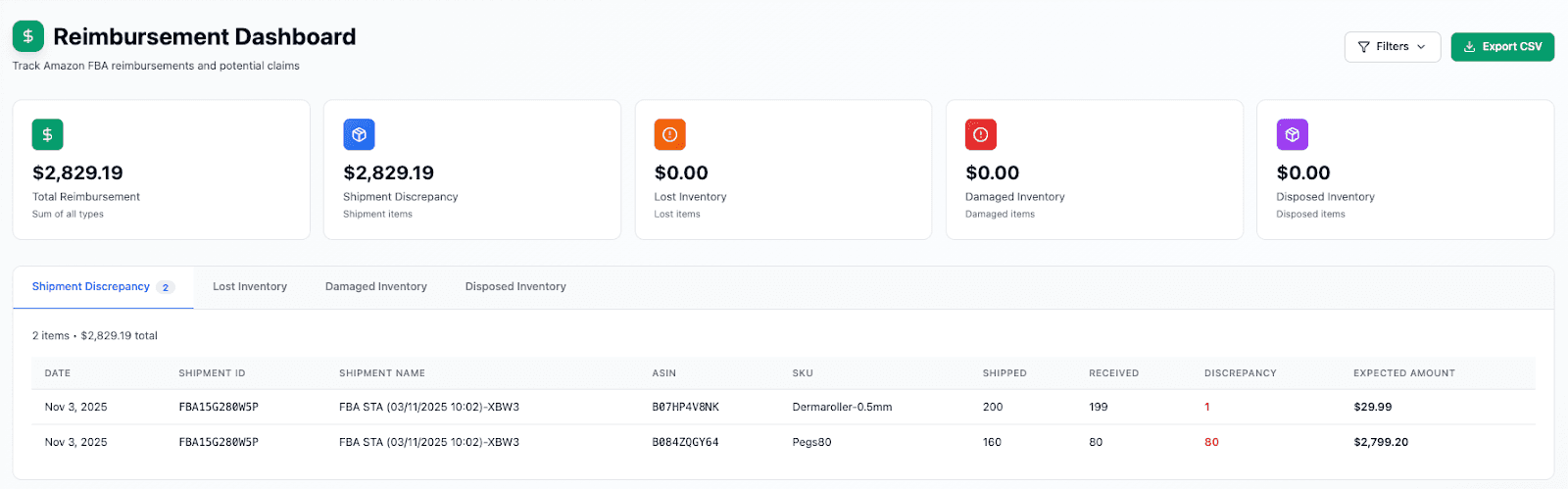
What makes this different from a generic Amazon fee calculator is that SellerQI doesn't just show you a number. It shows you the specific claim, the shipment ID, the dates, and the expected amount. You're not guessing. You're submitting claims with evidence.
The sellers who use SellerQI's reimbursement scanner typically recover between $500 and $5,000+ per account, depending on volume and how long they've been selling without auditing. That's money Amazon already owes you; it's just sitting unclaimed.
So, understanding your full Amazon FBA fees breakdown isn't just about knowing what you pay. It's about knowing when you've been overcharged and how to get it back.
The bottom line
The Amazon FBA fee structure is deliberately complex. Even when you go through an Amazon FBA fees breakdown, it rarely reveals the full picture. Between the hidden FBA costs most sellers never audit, the dimension errors Amazon doesn't flag, and the reimbursements sitting unclaimed across shipment and inventory categories, the real cost of selling on FBA is significantly higher than most profit calculators show.
The good news is that most of this money is recoverable, but only if you know where to look and act before the claim windows close. SellerQI's reimbursement dashboard gives you full visibility across every category, so you stop leaving money on the table and start claiming what's already yours.
FAQs
How do I calculate my true Amazon FBA fees?
The Amazon fee calculator only covers fulfillment and referral fees; it misses storage, return processing, and dimension overcharges. Use SellerQI to audit all fee categories automatically and see your real cost per unit in one dashboard.
How do I avoid Amazon FBA storage fees?
Monitor your IPI score, set up removal orders for slow-moving SKUs, and review aged inventory before the 15th of each month. Long-term storage fees kick in at 365 days, and catching it early is the only way to avoid the charge.
What is the Amazon FBA long-term storage fee?
Amazon charges $6.90 per cubic foot or $0.15 per unit, whichever is greater, for inventory stored beyond 365 days. Fees are assessed on the 15th of each month, so check your Inventory age report monthly to stay ahead of it.