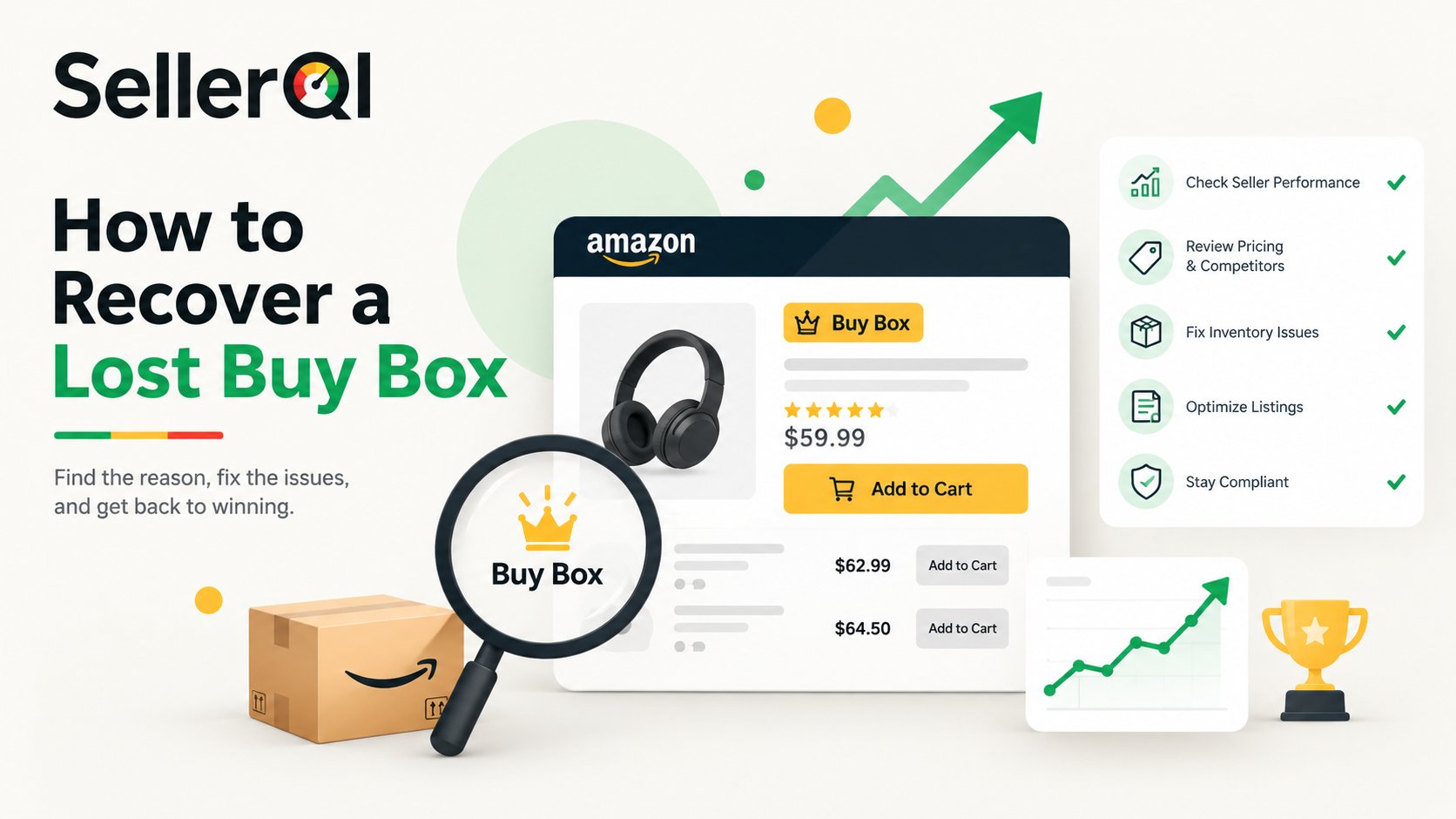
Amazon Buy Box loss can happen because of price competitiveness, fulfillment performance, seller metrics, inventory availability, offer quality, or changes in Amazon's offer evaluation. To recover it, sellers should first identify the specific reason their offer lost the Buy Box, correct the underlying issue, and consistently monitor price, fulfillment, stock, and account performance.
What is the Amazon Buy Box and why does it matter?
The Amazon Buy Box is the prominent purchase option on a product detail page that allows shoppers to add an offer to their cart or buy it directly. Winning the Buy Box gives a seller prominent placement when multiple sellers offer the same product.
For sellers competing on the same ASIN, Buy Box performance can directly affect how often shoppers encounter their offer as the default purchasing option.
An Amazon seller Buy Box strategy therefore involves more than simply lowering the product price. Sellers need to maintain a competitive and reliable offer across several factors.
What are Amazon Buy Box loss reasons?
Amazon buy box loss reasons are the factors that cause a seller's offer to lose the prominent Buy Box position on an Amazon product page. Common reasons include uncompetitive pricing, weaker fulfillment or delivery performance, inventory issues, seller-performance problems, shipping costs, and changes to competing offers. Identifying the specific reason helps sellers choose the right recovery action instead of relying only on price reductions.
Why did my Amazon product suddenly lose the Buy Box?
An Amazon product can suddenly lose the Buy Box because another seller has a more competitive overall offer, the current offer's price or fulfillment becomes less competitive, inventory or seller-performance conditions change, or Amazon's offer evaluation changes. The most important step is to identify which factor changed before attempting recovery, which is where AI Amazon seller analytics helps.
Ranked Amazon Buy Box loss reasons
- The offer is no longer competitively priced: Price is one of the first factors sellers should investigate. A competing seller may have introduced a lower-priced offer, changing the competitive landscape for the ASIN.
- Another seller has a stronger overall offer: Amazon evaluates competing offers rather than looking at price alone. A seller with stronger fulfillment, delivery, or offer conditions may become the preferred offer.
- Fulfillment performance has changed: Delivery speed, fulfillment method, shipping conditions, and reliability can influence offer competitiveness.
- Seller performance has deteriorated: Account health and seller-performance indicators can affect the ability to win the Buy Box consistently.
- The product is running low or has gone out of stock: Inventory availability can weaken an offer's competitiveness and create opportunities for another seller to win the Buy Box.
- Shipping costs or delivery terms have changed: A lower product price does not necessarily create the strongest overall offer if shipping costs or delivery conditions make the final offer less attractive.
- A competing seller changed their offer: Buy Box ownership can change when competitors adjust their prices, fulfillment methods, inventory, or offer conditions.
How should Amazon sellers monitor Buy Box performance?
Amazon sellers should monitor Buy Box performance at the ASIN level and compare changes against price, inventory, fulfillment, and competitor activity.
For important products, track:
| Metric | What to monitor |
|---|---|
| Buy Box percentage | Changes over time |
| Offer price | Your price vs. competitors |
| Inventory | Stock availability and stockouts |
| Fulfillment | Fulfillment method and delivery promise |
| Seller performance | Relevant account and performance indicators |
| Competition | Number and quality of competing offers |
| Sales | Changes alongside Buy Box performance |
This helps an Amazon seller Buy Box strategy become data-driven rather than reactive.
What are the main Amazon Buy Box loss reasons?
The main Amazon buy box loss reasons usually involve changes in offer competitiveness, pricing, fulfillment, seller performance, inventory, or competing offers. Because Buy Box ownership can change dynamically, sellers should compare their current offer with competing offers rather than assuming that one factor is always responsible. Knowing these factors will also help you win the Amazon Buy Box.
Price competitiveness
Compare your total customer-facing offer against other sellers on the same ASIN. Look beyond the product price and evaluate:
- Shipping cost
- Delivery speed
- Promotions
- Discounts
- Fulfillment method
- Overall customer value
Fulfillment and delivery
Reliable fulfillment can make an offer more competitive. Sellers should monitor whether delivery promises, handling times, and fulfillment conditions have changed.
Inventory availability
Maintaining sufficient stock is important when trying to maintain consistent Buy Box performance. Frequent stockouts can interrupt your ability to compete for the Buy Box.
Seller performance
Monitor account and seller-performance indicators regularly. Problems involving order handling, cancellations, returns, or customer experience can affect overall offer competitiveness.
How to do Amazon Buy Box recovery
To recover the Amazon Buy Box, identify the reason for the loss, compare your offer against competing sellers, correct pricing or fulfillment problems, restore inventory where necessary, and monitor your Buy Box percentage after making changes. You can also explore SellerQI Features to automate the monitoring.
A practical recovery process is:
- Confirm that the Buy Box was actually lost: Check whether another seller currently holds the prominent offer position.
- Compare competing offers: Review price, shipping, delivery promise, fulfillment method, and seller conditions.
- Check your inventory: Make sure the product is available and that stock levels are sufficient to support continued sales.
- Review seller performance: Look for account-health or performance issues that could weaken your offer.
- Correct the most significant disadvantage: Avoid making multiple unnecessary changes at once. Address the factor most clearly separating your offer from the competitive offer.
- Monitor Buy Box performance: Track whether your offer begins winning the Buy Box again after the corrective action.
Checklist to improve Amazon Buy Box win rate consistently
Use this checklist to create a repeatable process for improving and monitoring your Buy Box performance.
- Check your current Buy Box percentage for important ASINs.
- Compare your total offer price with competing sellers.
- Review shipping costs and delivery promises.
- Monitor competitor price changes.
- Maintain adequate inventory for high-priority products.
- Review fulfillment performance regularly.
- Monitor seller-performance and account-health metrics.
- Investigate sudden changes in Buy Box ownership.
- Check whether competitors have changed fulfillment methods.
- Avoid unnecessary price changes without reviewing the competitive offer.
- Track Buy Box performance after significant listing or offer changes.
- Identify ASINs with recurring Buy Box losses and investigate them separately.
- Document the cause of each significant Buy Box loss.
- Review the recovery results before making another offer adjustment.
Consistency matters because winning the Buy Box once is different from maintaining competitive offer performance over time.
Why does the Amazon Buy Box disappear even when my price is competitive?
The Amazon Buy Box can disappear even when your price is competitive because price is only one part of overall offer competitiveness. Fulfillment, shipping, delivery performance, seller metrics, inventory availability, and competing offer conditions can also influence which offer receives the prominent purchasing position.
For this reason, matching or beating a competitor's product price does not automatically guarantee Buy Box ownership. Low stock is a common hidden cause, which is why Amazon inventory alerts matter.
Can you recover the Buy Box without lowering your price?
Yes, depending on the reason for the loss. If your price is already competitive, lowering it further may not address the actual problem.
Instead, investigate:
- Fulfillment performance
- Delivery speed
- Shipping costs
- Inventory availability
- Seller-performance indicators
- Competitor offer changes
- Overall offer competitiveness
A price reduction should therefore be a considered response to a verified pricing disadvantage, not an automatic Buy Box recovery tactic.
How can you prevent future Buy Box loss?
Preventing future Buy Box loss requires continuous monitoring rather than a one-time recovery action. Sellers should keep pricing competitive, maintain inventory, monitor fulfillment, protect seller performance, and watch significant competitor offer changes.
A proactive process can include:
- Daily monitoring for high-value ASINs
- Regular competitor offer checks
- Inventory alerts
- Fulfillment-performance monitoring
- Seller-account health reviews
- Buy Box percentage tracking
- Documentation of recurring loss patterns
The goal is not simply to recover a lost Buy Box but to understand the conditions that consistently support competitive offer performance.
Frequently asked questions
What are the most common Amazon buy box loss reasons?
The most common Amazon buy box loss reasons include an uncompetitive total offer, fulfillment or delivery issues, insufficient inventory, seller-performance problems, shipping conditions, and stronger competing offers. Sellers should compare their offer with the current Buy Box winner to identify the factor that changed.
How does Amazon Buy Box recovery work after losing the Buy Box?
Amazon Buy Box recovery starts by identifying why the offer lost the Buy Box and then correcting the relevant issue. Sellers should review price, fulfillment, shipping, inventory, seller performance, and competitor offers before deciding which recovery action to take.
What should an Amazon seller do after losing the Buy Box?
An Amazon seller Buy Box recovery process should begin with a comparison of the seller's offer against the current featured offer. Check total price, fulfillment, delivery promise, inventory, and seller-performance factors, then address the most significant competitive disadvantage.
Why has my Amazon Buy Box disappeared even though my listing is active?
If the Amazon Buy Box disappeared while the listing remains active, the offer may have become less competitive than another seller's offer. Check competing prices, fulfillment methods, shipping costs, inventory, and delivery conditions before assuming the listing itself has a technical problem.
What is the best Amazon Buy Box recovery strategy?
An effective Amazon Buy Box recovery strategy combines diagnosis, competitive comparison, targeted correction, and ongoing monitoring. Instead of automatically lowering the price, sellers should first determine whether pricing, fulfillment, inventory, seller performance, or another offer factor caused the Buy Box loss.
Can Amazon Buy Box recovery happen without changing the product price?
Yes. Amazon Buy Box recovery may be possible without a price change when the underlying problem involves fulfillment, shipping, inventory, delivery conditions, or seller performance. If the offer is already competitively priced, changing another weak factor may be more appropriate.
How can an Amazon seller prevent the Buy Box from disappearing again?
An Amazon seller Buy Box monitoring process can help prevent recurring losses. Regularly track Buy Box percentage, competitor offers, inventory, fulfillment performance, pricing, and seller-performance indicators so that significant changes can be identified before they repeatedly affect Buy Box ownership.