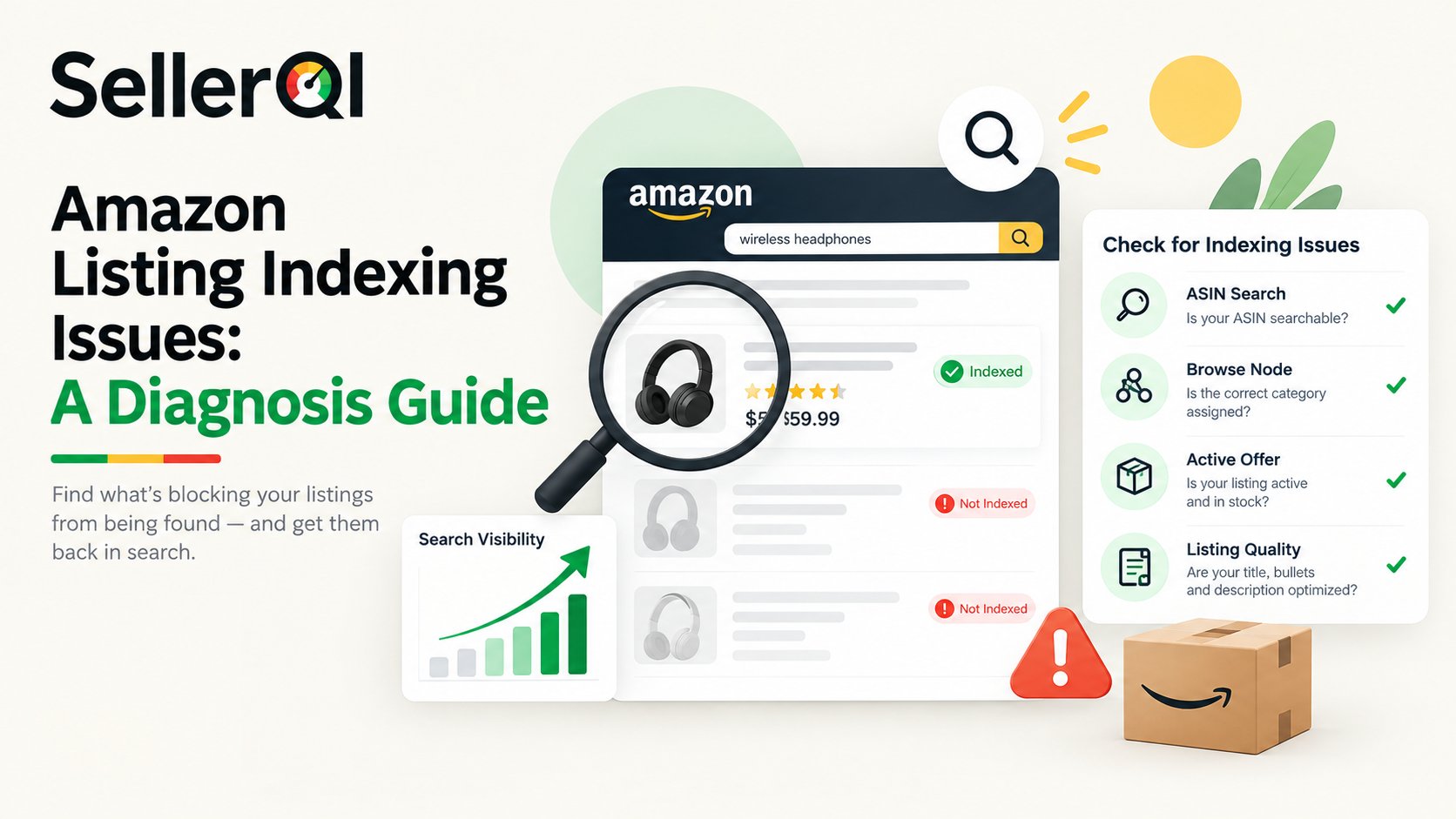
Amazon listing indexing issues and diagnosis usually occur when Amazon has not properly crawled, processed, or made a product eligible for relevant search queries. Common causes include listing suppression, incomplete or conflicting product data, indexing delays, category or compliance problems, and weak keyword relevance. Diagnosing the specific cause helps sellers restore visibility faster.
What are Amazon listing indexing issues?
Amazon listing indexing issues happen when a product listing fails to appear in Amazon search results for keywords that should be relevant to the product. A listing can be active and purchasable while still having limited or incomplete search visibility.
This distinction is important because Amazon product not showing in search does not always mean the product is unavailable. The listing may be live on its detail page but not properly indexed for particular search terms.
Amazon indexing generally depends on factors such as:
- Listing content and product information
- Search-term relevance
- Product category and attributes
- Listing eligibility and compliance
- Product status and suppression issues
- Amazon's catalog and search systems
- Historical listing or catalog changes
Why is my Amazon product listing not indexing?
Your Amazon product listing may not be indexing because Amazon has not recognized the product or its content as sufficiently eligible and relevant for the search query. Common causes include incorrect keywords, missing attributes, suppressed content, category issues, listing changes, and indexing delays.
Common causes of Amazon listing indexing issues
The target keyword is not present in relevant listing fields: If an important search term is absent from the product's relevant content or structured data, Amazon may have limited signals connecting the listing with that query.
The listing contains weak or irrelevant keyword signals: Adding keywords is not enough. The terms need to accurately describe the product and align with shopper search intent.
The product has a catalog or category problem: Incorrect product types, categories, attributes, or catalog relationships can interfere with search visibility.
The listing is suppressed or has compliance issues: A listing can experience visibility problems when Amazon identifies missing information, policy concerns, restricted claims, or other listing issues.
Recent listing changes have not fully propagated: Significant edits to titles, attributes, bullet points, categories, or other listing information may require time before their effects are reflected throughout Amazon's systems.
The search query does not closely match the product: A product may be indexed for some highly relevant terms but not appear for broader or less-specific queries.
The listing has a visibility or ranking problem rather than an indexing problem: A product can be indexed but rank so low that it is difficult to find in search results. This is one reason Amazon product ranking issues should be diagnosed separately from indexing.
How do you diagnose Amazon listing indexing problems fast?
You can diagnose Amazon listing indexing problems by checking the listing's search visibility, keyword presence, indexing status, listing health, and search position in sequence. Start with the exact search query, then verify the listing and keyword signals before investigating catalog, compliance, or ranking factors.
Follow this 5-step diagnostic sequence
- Search Amazon using the exact target keyword: Start with the keyword for which the product should appear. Use the same marketplace and customer-facing search environment relevant to your listing.
- Check whether the product appears for its exact ASIN or product identifier: If the product can be found directly but not through the target keyword, the issue may be keyword indexing or relevance rather than overall product availability.
- Review the listing's keyword and product information: Check the title, bullet points, description, backend search terms, category, attributes, and other relevant fields. Confirm that important terms accurately describe the product.
- Check listing health and catalog status: Look for suppressed content, missing attributes, category errors, compliance warnings, or other issues that could affect discoverability.
- Separate indexing from ranking: If the listing appears for the target query but is buried deep in the results, you may be dealing with an Amazon product ranking issue rather than an indexing failure.
This sequence prevents sellers from immediately changing keywords when the underlying problem may be listing status, catalog data, or search ranking.
What is the difference between Amazon indexing and ranking?
Amazon indexing determines whether a product can be retrieved for a relevant search query, while ranking determines where that product appears among the eligible search results. You can refer to SellerQI Services for hands-on help.
For example, if a product is indexed for "wireless gaming mouse" but appears on a distant results page, the primary problem may be ranking rather than indexing.
Amazon indexing vs. ranking
| Issue | What it means | Typical symptom |
|---|---|---|
| Indexing | Amazon recognizes the listing as relevant to a query | Product can appear for the search |
| Ranking | Amazon determines the product's position among results | Product appears but is difficult to find |
| Listing visibility | Overall ability of shoppers to discover the product | Product receives limited search exposure |
| Listing suppression | Amazon restricts or limits the listing because of an issue | Product may have reduced or no normal visibility |
Understanding this difference is essential when diagnosing Amazon SEO indexing issues. Otherwise, sellers may repeatedly edit listing copy when the actual problem is ranking or listing eligibility.
Why does an Amazon listing get indexed for some keywords but not others?
An Amazon listing can be indexed for some keywords but not others because Amazon evaluates the relevance and relationship between the product and each individual search query.
A listing may have strong relevance for a specific product term but weaker relevance for broader, adjacent, or differently worded searches.
For example, a product could appear for a highly specific phrase such as "stainless steel insulated water bottle" but not perform similarly for a broader term such as "water bottle."
This is why sellers should test multiple relevant queries rather than using a single search as proof that the entire listing is or is not indexed.
How can you check whether an Amazon product is indexed?
To check indexing, test whether the product can be retrieved for specific relevant search terms and compare those results with the listing's product information.
A practical check includes:
- Select a specific target keyword.
- Search the keyword on the correct Amazon marketplace.
- Determine whether the product appears.
- Test several closely related, highly relevant terms.
- Check whether recent listing edits have been processed.
- Compare indexing results over time rather than relying on one isolated search.
Third-party Amazon SEO and analytics tools can also help sellers monitor keyword visibility and identify changes across larger keyword sets.
How do Amazon listing visibility issues affect sales?
Amazon listing visibility issues can reduce the number of shoppers who discover a product through search. Lower visibility can reduce opportunities for clicks, product-page visits, and ultimately conversions. Visibility can also suffer if a listing is violating Amazon policy.
However, visibility should not be treated as a single metric. A listing can have strong visibility for some queries while being absent or poorly positioned for others.
Sellers should therefore evaluate:
- Keyword indexing
- Organic search position
- Search impressions
- Click-through rate
- Conversion rate
- Sales trends
- Listing availability
- Buy Box performance
- Advertising performance
This broader view helps determine whether the problem is primarily indexing, ranking, conversion, or another part of the Amazon sales funnel.
When is an indexing problem actually a ranking problem?
An indexing problem is actually a ranking problem when the product is already appearing for the target search query but has insufficient visibility because it ranks too low.
For example, if a product appears when searching its relevant keyword but is several pages deep in the results, the listing may already be indexed.
In this situation, sellers should investigate factors affecting search performance instead of treating the listing as completely unindexed. Another cause can be changes to your Amazon listing.
Potential areas to review include:
- Keyword relevance
- Listing quality
- Click-through behavior
- Conversion performance
- Sales velocity
- Competitive positioning
- Product availability
- Price and offer competitiveness
How can sellers prevent future Amazon listing indexing issues?
Sellers can reduce future indexing problems by maintaining accurate product data, monitoring keyword visibility, documenting listing changes, and regularly checking listing health.
A simple monitoring process can include:
- Track important target keywords.
- Check major listing changes after implementation.
- Monitor suppressed or inactive listings.
- Review category and attribute accuracy.
- Watch for sudden visibility changes.
- Separate indexing changes from ranking changes.
- Maintain a record of listing updates.
Regular monitoring makes it easier to identify Amazon product not showing in search situations before they become persistent visibility problems.
Frequently asked questions
Why is my Amazon product not showing in search results?
An Amazon product not showing in search can be caused by keyword relevance issues, listing suppression, incorrect category or attributes, incomplete product information, or a search ranking problem. First determine whether the product is completely absent or simply ranking too low for the target query.
Can incorrect keywords cause Amazon search indexing issues?
Yes. Amazon search indexing issues can occur when relevant search terms are missing, poorly matched to the product, or used in a way that does not accurately describe the listing. Review your primary and secondary keywords across the appropriate listing fields.
How do I know if I have Amazon product ranking issues instead of indexing issues?
You may have Amazon product ranking issues if your product appears for the target keyword but is positioned too far down the search results to receive meaningful visibility. If the product does not appear for a highly relevant query at all, investigate indexing first.
What should I check when I have Amazon SEO indexing issues?
When troubleshooting Amazon SEO indexing issues, check keyword relevance, listing content, product attributes, category selection, backend search terms, listing status, and recent catalog changes. These checks can help determine whether the problem is related to indexing, listing eligibility, or ranking.
Why has my listing suddenly lost Amazon search visibility?
Amazon listing visibility issues can result from listing edits, catalog changes, suppressed content, compliance problems, changes in keyword relevance, or increased competition. Compare the timing of the visibility drop with recent changes to the listing and its search performance.
Does Amazon listing content affect keyword indexing?
Yes. Product titles, bullet points, descriptions, attributes, and other relevant listing information can contribute to how Amazon understands a product's relevance to search queries. Accurate and naturally optimized content provides clearer signals than simply adding large numbers of keywords.
Can a listing be indexed but still have poor search visibility?
Yes. A listing can be indexed for a keyword while appearing far down the search results. In that situation, the issue is primarily related to search ranking rather than basic indexing, so sellers should investigate Amazon product ranking issues separately from indexing.