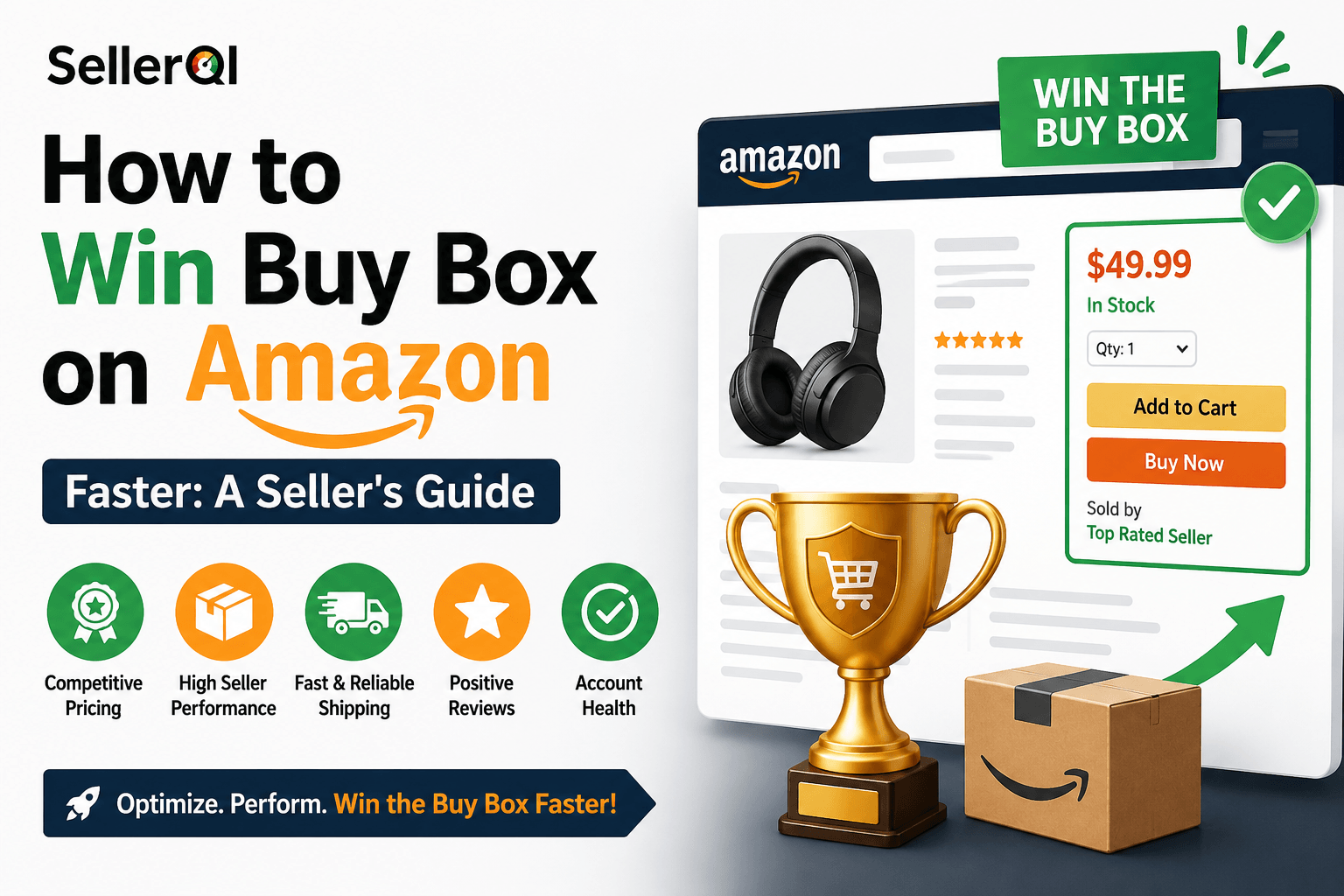
To win the Amazon Buy Box you need a Professional Seller account, a competitive landed price (item + shipping), FBA or fast FBM fulfillment, strong seller metrics (ODR below 1%, on-time shipping above 97%), and consistent in-stock inventory. FBA is the fastest path to eligibility.
More than 82% of Amazon sales are driven by the Buy Box. If you're not winning it, you're not just losing visibility. You're handing every sale to a competitor. This guide covers what Amazon actually weighs, why sellers struggle, and exactly what to fix.
Why you're not winning the Buy Box
The core problem: most sellers focus on the wrong variable. Price is not the Buy Box. Landed price, seller metrics, and fulfillment together decide who wins. Here are three of the most common complaints sellers actually share, and how to fix each one.
"I'm using FBA and matched the price. Why am I still not winning?"
This is the most common complaint from new sellers. The algorithm weighs sales history and account credibility alongside price. A brand-new account with zero order history and zero feedback is a risk to Amazon's customer experience. The algorithm needs to trust you before featuring you. FBA makes you eligible faster, but it doesn't guarantee immediate rotation.
The fix: price 3–5% below the current Buy Box winner for your first 30–60 days. Run a small PPC campaign to generate early orders. Build your first 10 feedback ratings. Once you have a clean performance history, the algorithm starts rotating you in.
"I'm the only seller on the listing and still no Buy Box"
Amazon suppresses the Buy Box entirely when no offer meets its value threshold for customers. Even as the sole seller, if your price is above what Amazon considers acceptable for that category, or your seller metrics fall below the eligibility floor, the Buy Box disappears.
The fix: check that your price is competitive with comparable products in the category, and audit your Account Health metrics in Seller Central. Amazon will not award the Buy Box simply because you're the only option.
"I'm eligible but never seem to get my rotation turn"
Eligibility and rotation share are two different things. Getting into the Buy Box pool means Amazon considers you. How much time you spend featured depends on how you rank against every other eligible seller across all weighted factors simultaneously. If you're 6th out of 7 eligible sellers, you may see less than 5% rotation time.
The fix: in Seller Central, go to Reports → Business Reports → Detail Page Sales and Traffic by Child Item and find the "Buy Box Percentage" column. Track it weekly by ASIN. Identify which metric slipped when your share dropped, that's the one variable to fix first.
Buy Box eligibility: the hard requirements
Before optimising for rotation share, you must clear every eligibility gate. These are hard requirements: fail any one of them and you're out of contention regardless of price.
| Requirement | Threshold | Notes |
|---|---|---|
| Seller account type | Professional ($39.99/mo) | Individual accounts are not eligible |
| Order Defect Rate | Below 1% | Negative feedback, A-to-Z claims, chargebacks |
| Pre-fulfillment cancel rate | Below 2.5% | FBA sellers are immune to this metric |
| Late shipment rate | Below 4% | FBM sellers must track this weekly |
| In-stock inventory | Yes, at all times | A stockout means immediate Buy Box loss |
The Buy Box algorithm: every factor that matters in 2026
Amazon's algorithm uses a two-stage process: first filter by eligibility, then rank and rotate eligible sellers. After the May 2025 multi-factor update and the October 2025 zero-day handling requirement, fulfillment speed and operational metrics now carry more weight than pricing alone.
1. Landed price, not item price
Amazon compares your total cost to the customer: item price plus shipping. A $32 product with free Prime shipping ($32 landed) beats a $30 product with $5 shipping ($35 landed). A $0.50 difference at the 5% price boundary can be the difference between featured and invisible in "More Buying Choices." Always calculate and compete on landed price, not item price.
2. Fulfillment method
FBA is the single strongest lever after price. Amazon gives FBA sellers automatic perfect scores on all fulfillment-related metrics: shipping speed, valid tracking, handling time. The October 2025 update added 0-day handling as a significant weight factor, which FBA meets by default. FBM sellers must manually achieve the same results and sustain them, which is why the Buy Box gap between FBA and FBM has widened.
3. Seller performance metrics
ODR, late shipment rate, feedback score, response time, and return rate feed the algorithm continuously. Brief dips cause immediate Buy Box loss. The algorithm has no memory of past wins. Sellers with sub-0.5% ODR and 0-day handling see disproportionate gains in rotation share from even small metric improvements.
4. Inventory depth
Sellers with deeper, more stable inventory win more rotation time. Amazon penalises chronically low stock, not just actual stockouts. Maintaining 30–45 days of inventory coverage signals reliability and protects your rotation share even during restocking lead times.
5. Price parity across channels
If your product is listed cheaper on your own website or another marketplace, Amazon may suppress your Buy Box even if your Amazon price is competitive against other sellers on the same listing. Always maintain price parity across channels, or keep Amazon as your lowest channel.
How to win the Amazon Buy Box as a new seller
New sellers can enter Buy Box rotation within 30–60 days by using FBA, pricing below the current winner, running PPC for early velocity, and keeping first orders defect-free. Account age matters far less than performance history.
- Weeks 1–2: upgrade to Professional, send stock to FBA, price 3–5% below the Buy Box winner's landed price, and complete your listing (images, bullets, A+ content if brand registered).
- Weeks 2–4: run Sponsored Products on your own ASIN to generate early orders. Use Amazon's "Request a Review" feature for every eligible order, and monitor Account Health daily.
- Weeks 4–8: check Buy Box percentage weekly in Business Reports. As rotation share grows, gradually bring your price back up toward the Buy Box price. The algorithm responds to your improving track record.
FBM sellers: can you still win the Buy Box?
Yes, but only if your landed price significantly undercuts FBA offers (often 10–20% lower) and your seller metrics match FBA performance standards. The most practical path for FBM sellers is Seller Fulfilled Prime (SFP), which provides the Prime badge without using Amazon's warehouses.
As FBM, you must set 0–1 day handling time and hit it on every order, maintain 97%+ on-time delivery, use valid tracking on every shipment, and price at least 5–15% below comparable FBA offers. One week of late shipments can push you out of rotation for weeks afterward.
The SFP path: Seller Fulfilled Prime requires 99%+ on-time delivery and same-day or next-day handling, but sellers who qualify achieve Buy Box win rates close to FBA levels. If you're consistently strong on FBM metrics, SFP is worth pursuing.
Seller metrics that directly control your Buy Box share
These five metrics determine how much Buy Box rotation time you receive. The algorithm has no memory of past wins, a brief dip in any metric causes immediate rotation loss.
| Metric | Target | Why it matters |
|---|---|---|
| Order Defect Rate (ODR) | Below 0.5% | Negative feedback, A-to-Z claims, chargebacks |
| Late shipment rate | Below 2% | FBM sellers must hit every promised ship date |
| Valid tracking rate | Above 95% | Required since Amazon's Jan 2025 update |
| Customer response time | Under 24 hours | Faster responses carry higher Buy Box weight |
| Feedback score | Above 4.7 / 5 | Recent feedback weighted more than older reviews |
ODR is the most critical single metric. Even one A-to-Z claim on a small account can spike ODR above 1% overnight. Sellers with sub-0.5% ODR consistently see higher rotation share than the eligibility minimum requires.
For feedback score and velocity, Amazon weights recent feedback more heavily than older reviews. A seller with 500 reviews and three recent negatives is algorithmically weaker than a seller with 100 reviews and no recent negatives. Consistent use of Amazon's "Request a Review" button is one of the lowest-cost Buy Box improvements available.
Pricing strategy that wins without killing margins
The winning strategy is not the lowest price, it's the most competitive landed price within roughly 5% of the Buy Box winner, combined with strong seller metrics. Automated repricing keeps you in this range dynamically. Sellers using AI-driven pricing see up to 25% more Buy Box share compared to manual pricing.
Manual repricing cannot keep pace with a Buy Box that rotates throughout the day and responds to competitor changes in real time. Set a floor price (your profitability threshold, never breach it), set a ceiling, and let the repricer keep you in the optimal competitive window automatically.
Key warning: chasing the lowest price without addressing metrics destroys margins while achieving nothing. An FBA seller with 0.3% ODR at $25.99 will beat an FBM seller at $23.99 in most competitive scenarios.
How SellerQI helps you win and hold the Buy Box
Winning the Buy Box once is tactical. Holding Buy Box share consistently across multiple ASINs, through algorithm updates and against shifting competitors, is what SellerQI is built for.
- Know your Buy Box percentage by ASIN, who's winning when you're not, and how your landed price compares.
- Dynamic repricing that stays competitive automatically, with your margin floor protected.
- Daily metric monitoring with early warnings before any threshold impacts your rotation share.
- Restock flags before stockouts reset your Buy Box momentum.
- Visibility into which sellers are rotating into your Buy Box and when they're most active.
Frequently asked questions
Does Amazon automatically win the Buy Box over third-party sellers?
No. Amazon's retail offers compete in the same algorithm as third-party sellers. Third-party sellers with a lower landed price and competitive metrics can and do beat Amazon in the Buy Box. However, Amazon's fulfillment scores are inherently perfect and its inventory is effectively unlimited, so the required price advantage is significant.
Can I win the Buy Box if I'm the only seller on a listing?
Amazon only shows the Buy Box if your offer is good enough by its standards. If it isn't, Amazon simply won't show it, even if you're the only seller on the listing. When that happens, it's usually one of two things: your price is too high for that category, or your seller stats (shipping speed, ratings, and so on) aren't where they need to be.
How long after going Pro until I get the Buy Box?
Most new Professional sellers using FBA start seeing Buy Box rotation within 30–60 days, assuming competitive pricing and no account defects. FBM sellers typically wait 60–90 days and need significantly lower prices. There is no fixed timer, the algorithm responds to performance history, not account age.
What happens when I run out of stock?
You lose Buy Box eligibility immediately when inventory hits zero. Worse, the algorithm's reliability assessment of your account is negatively affected, so your rotation share is typically lower for a period even after you restock. Preventing stockouts is one of the highest-leverage Buy Box actions available.
The Amazon Buy Box is not won by one clever trick. It's won by consistently executing across landed price, fulfillment reliability, seller metrics, and stable inventory, and monitoring all of them simultaneously. SellerQI brings all of these levers into one platform.