TL;DR
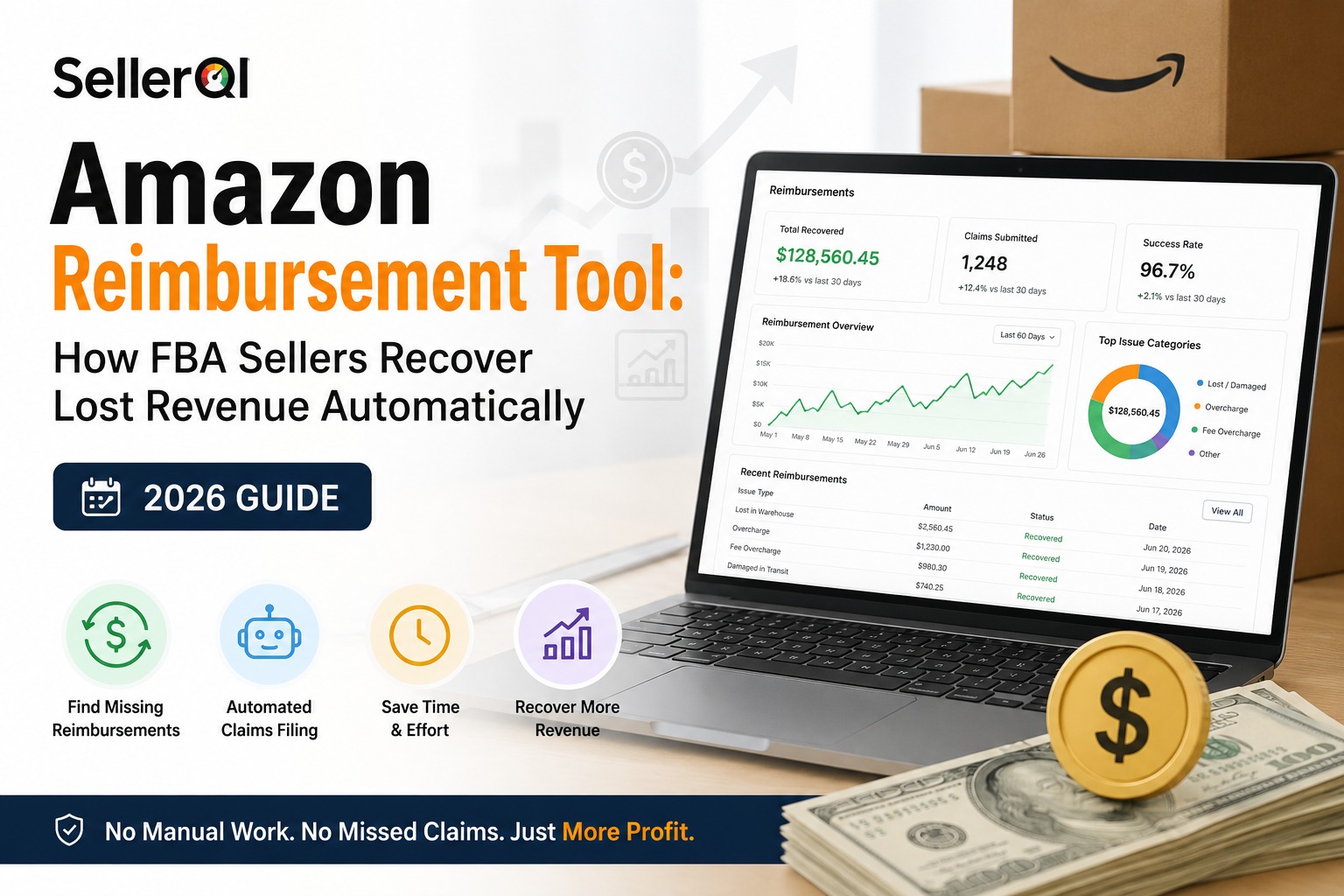
An Amazon reimbursement tool checks your inventory, fees, and shipments for mistakes. It shows you lost units, damaged units, or extra fees you may be able to claim back.
Sellers lose money in a few common ways: warehouse handling errors, shipment mismatches, wrong fees, refunds that never get returned, and inventory lost while moving between warehouses.
Manual tracking can work if you only have a few products. But once your SKU count and order volume grow, it gets hard to keep up.
Reimbursement tools don't guarantee you'll get paid. Amazon has the final say on every claim. What these tools actually do is help you catch problems before the filing deadline passes.
Look for a tool that catches a wide range of errors, shows clear reports, tracks filing deadlines, and connects securely through the API. Stay away from tools that promise guaranteed money back, since no tool can promise that.
SellerQI scans your account for possible inventory and fee errors, then shows them to you. You decide which ones are worth filing a claim for.
Open your FBA inventory report right now and you'll probably find at least one number that doesn't add up, a missing unit here, a fee that looks off there. Most sellers scroll right past it, and that's exactly how thousands of dollars a year quietly slip out of their business.
Amazon's warehouses process millions of units a day. At that volume, errors aren't rare exceptions, they're a predictable cost of doing business at scale. The sellers who recover that money aren't the ones who work harder. They're the ones who have a system that catches the discrepancy before the claim window closes.
This guide shows you exactly what an Amazon reimbursement tool does, the money-losing scenarios it's built to catch, and how to tell a genuinely useful tool from an overhyped one, so you can decide whether it's time to stop leaving eligible revenue on the table.
What an Amazon reimbursement tool actually does
An Amazon reimbursement tool is software that checks your FBA account for problems like lost, damaged, or overcharged units. It helps you find issues that might qualify for a reimbursement claim. Instead of checking multiple reports by hand, the tool does that work for you.
These tools connect to your Seller Central account through Amazon's Selling Partner API. Once connected, they pull data from your inventory, fee, and shipment reports. Then they compare the numbers to find things that don't match up.
Some tools just find and report the problems, you still have to file the claim yourself. Other tools go a step further and help you file the claim too. Either way, the goal is the same: find the money-losing errors that would otherwise stay buried in reports you don't have time to dig through. SellerQI takes this same approach as part of a broader reimbursement and account health checksomething we'll get into a bit later in this guide.
Why Amazon sellers lose money
Amazon's fulfillment network moves an enormous volume of inventory through warehouses, trucks, and sortation centers every single day. At that scale, some errors are inevitable. The issue is that most of them are invisible unless you go looking for them.
Here are the main reasons FBA sellers lose money without realizing it:
Warehouse handling errors. Units get misplaced, mislabeled, or scanned incorrectly during receiving or storage.
Shipment discrepancies. The quantity Amazon confirms receiving doesn't match what you actually shipped.
Fee miscalculations. Amazon assigns the wrong size tier, weight, or storage category to a product.
Return processing gaps. A customer's refund is issued, but the unit never makes it back into sellable inventory.
Inter-warehouse transfers. Inventory moving between fulfillment centers goes missing in transit.
None of these individually sound catastrophic. But across hundreds or thousands of units a month, they add up to real, ongoing revenue loss, the kind that rarely shows up unless someone is actively reconciling the numbers. Many of these leaks overlap with the hidden FBA fees most sellers miss.
Common reimbursement scenarios
Here's a simple look at the situations that most often lead to an Amazon FBA reimbursement:
| Scenario | What happens | Potential outcome |
|---|---|---|
| Lost inventory | Your units go missing inside an Amazon warehouse | You may get paid back for the lost units |
| Damaged inventory | Amazon damages your stock while handling or storing it | You may get paid back for the damaged units |
| Customer returns | A customer gets refunded, but the item never comes back to inventory | You may get paid back for the missing unit |
| Overcharged fees | Amazon charges you the wrong weight or size fee | You may get the fee fixed or refunded |
| Destroyed inventory | Amazon throws away your stock without your OK | You may get paid back for the destroyed units |
| Warehouse transfer loss | Your inventory goes missing while moving between warehouses | You may get paid back once the loss is confirmed |
Example: Say you ship 200 units of a kitchen product to an Amazon warehouse. The receiving report only confirms 185 units arrived. Fifteen units simply vanished between the carrier drop-off and Amazon's inventory count. That gap is a textbook case for a lost-inventory claim, but only if someone catches it before the eligibility window closes.
Benefits of using a reimbursement tool
The core value of a reimbursement tool comes down to time, accuracy, and consistency.
Saves hours of manual reconciliation work each month.
You're less likely to miss Amazon's claim filing deadlines.
It checks every SKU the same way, not just your best sellers.
It helps you spot fee errors that are easy to miss on your own.
You get more time to focus on sourcing, listings, and ads instead of digging through spreadsheets.
It's worth being clear-eyed here: no tool can guarantee that every flagged discrepancy results in an approved reimbursement. Amazon makes the final determination on every claim. What a good tool does is improve your odds of catching eligible issues before they fall outside the claim window.
Features to look for
Not all reimbursement tools operate the same way. When evaluating options, look for these capabilities:
Broad discrepancy detection across lost, damaged, and destroyed inventory.
Checks whether you've been overcharged on referral, storage, or fulfillment fees.
Compares what you shipped, what Amazon received, and what actually sold over time.
Explains why each issue was flagged, not just that something's wrong.
Keeps track of deadlines, since Amazon only accepts claims within a specific window.
Secure API-based access rather than requiring your Seller Central login credentials.
Transparent, non-exaggerated claims about what the tool can and cannot do.
That last point matters more than it might seem. Reimbursement software should help you find opportunities. It shouldn't promise guaranteed payouts, since Amazon alone decides whether a claim is approved.
Manual tracking vs a reimbursement tool
Some sellers still track discrepancies manually, usually early on when order volume is low. Here's how that approach compares to using dedicated software.
| Factor | Manual tracking | Amazon reimbursement tool |
|---|---|---|
| Time needed | A few hours every week checking reports | A few minutes to check flagged issues |
| What it covers | Only what one person can check by hand | Checks inventory, fees, and shipments all the time |
| Catching errors | Easy to miss things, especially at scale | Checks every SKU the same way, every time |
| Deadlines | Easy to miss Amazon's filing windows | Flags issues while there's still time to file |
| Growing your store | Gets harder as you add more products | Keeps up as your catalog grows |
| Best for | Small stores with very few orders | Growing stores with regular FBA activity |
For a seller moving a few dozen units a month, manual tracking might be manageable. Once volume climbs into the hundreds or thousands of units, though, the odds of catching every discrepancy by hand drop significantly.
How SellerQI helps identify reimbursement opportunities
SellerQI is built to help FBA sellers monitor their account health, including areas where inventory and fee discrepancies tend to occur.
Within its broader account audit, SellerQI reviews inventory and fee data connected to your Seller Central account to help surface situations that may warrant a closer look, such as inventory quantities that don't reconcile across reports, or fee charges that appear inconsistent with a product's listed dimensions.
Rather than presenting a black-box output, SellerQI is designed to show sellers what was flagged and why, so you can review each item and decide how to proceed. This keeps you in control of the final call on any Amazon reimbursement claim, while removing the burden of manually building that analysis from scratch every week.
It's worth noting plainly: SellerQI does not control Amazon's reimbursement decisions, and identifying a discrepancy is not the same as guaranteeing a reimbursement. Amazon evaluates every submitted claim against its own policy and eligibility rules. What SellerQI aims to do is make the discrepancies easier to find in the first place, so fewer of them go unnoticed.
Common mistakes sellers make
Waiting too long to check reports and missing the deadline to file a claim.
Ignoring small errors, when they actually add up over time.
Filing a claim without enough proof, which gets it denied.
Relying on memory instead of checking reports regularly.
Not following up to see if old claims actually got paid.
Only checking for lost or damaged units and missing fee errors.
Best practices
Review your inventory and fee reports on a regular schedule, not just when something looks obviously wrong.
Keep records of shipment quantities so you have something concrete to compare against Amazon's receiving data.
File claims as soon as a discrepancy is confirmed, rather than batching them and risking missed deadlines.
Use a reimbursement tool alongside, not instead of, a basic understanding of Amazon's reimbursement policy.
Track claim outcomes so you can spot recurring issues, like a specific warehouse or SKU that generates repeat discrepancies.
Treat reimbursement recovery as ongoing account maintenance, not a one-time cleanup project.
Frequently asked questions
What is an Amazon reimbursement tool used for?
If you sell on Amazon FBA, you're probably losing money without even knowing it, inventory goes missing in warehouses, units get damaged, or Amazon just gets a fee calculation wrong. An Amazon reimbursement tool is what catches all of that for you.
Is Amazon reimbursement software safe to connect to my Seller Central account?
Only connect Amazon seller tools that use Amazon's official Selling Partner API, never ones that ask for your email and password directly. Check how they use and store your data before connecting.
How much money can I recover with a reimbursement tool?
There's no fixed refund amount; it depends on your order volume, product count, and how many errors are actually in your account. If a tool promises you an exact dollar figure upfront, be cautious. No one can guarantee that.
Does Amazon automatically reimburse sellers for lost or damaged inventory?
Amazon does automatically reimburse some errors. But for many others, you have to spot the issue yourself and file a claim before the deadline. That's the gap reimbursement tools are designed to fill.
How long do I have to file an Amazon reimbursement claim?
Filing windows vary by claim type and are set by Amazon's own reimbursement policy. In general, claims filed sooner after a discrepancy occurs have a better chance of falling within the eligible timeframe.
Does SellerQI file reimbursement claims for me?
SellerQI focuses on identifying potential discrepancies within your account data so you can review and act on them. Sellers should confirm current claim-filing capabilities directly with SellerQI, since product features can change over time.
Protect your Amazon profits with SellerQI
Errors happen a lot when you sell on Amazon at scale. But that doesn't mean you should let them slide. Lost inventory, damaged units, missing refunds, and wrong fees can slowly eat into your profits if no one's keeping track.
An Amazon reimbursement tool won't guarantee a specific payout, and it won't override Amazon's own claim review process. What it can do is take the manual reconciliation work off your plate and help you catch discrepancies while they're still eligible for a claim.
If you're managing a growing FBA catalog and haven't reviewed your inventory and fee reports recently, that's a reasonable place to start. Tools like SellerQI are built to make that review faster, giving you clearer visibility into where your reimbursement opportunities might be, so you can decide what to do next.