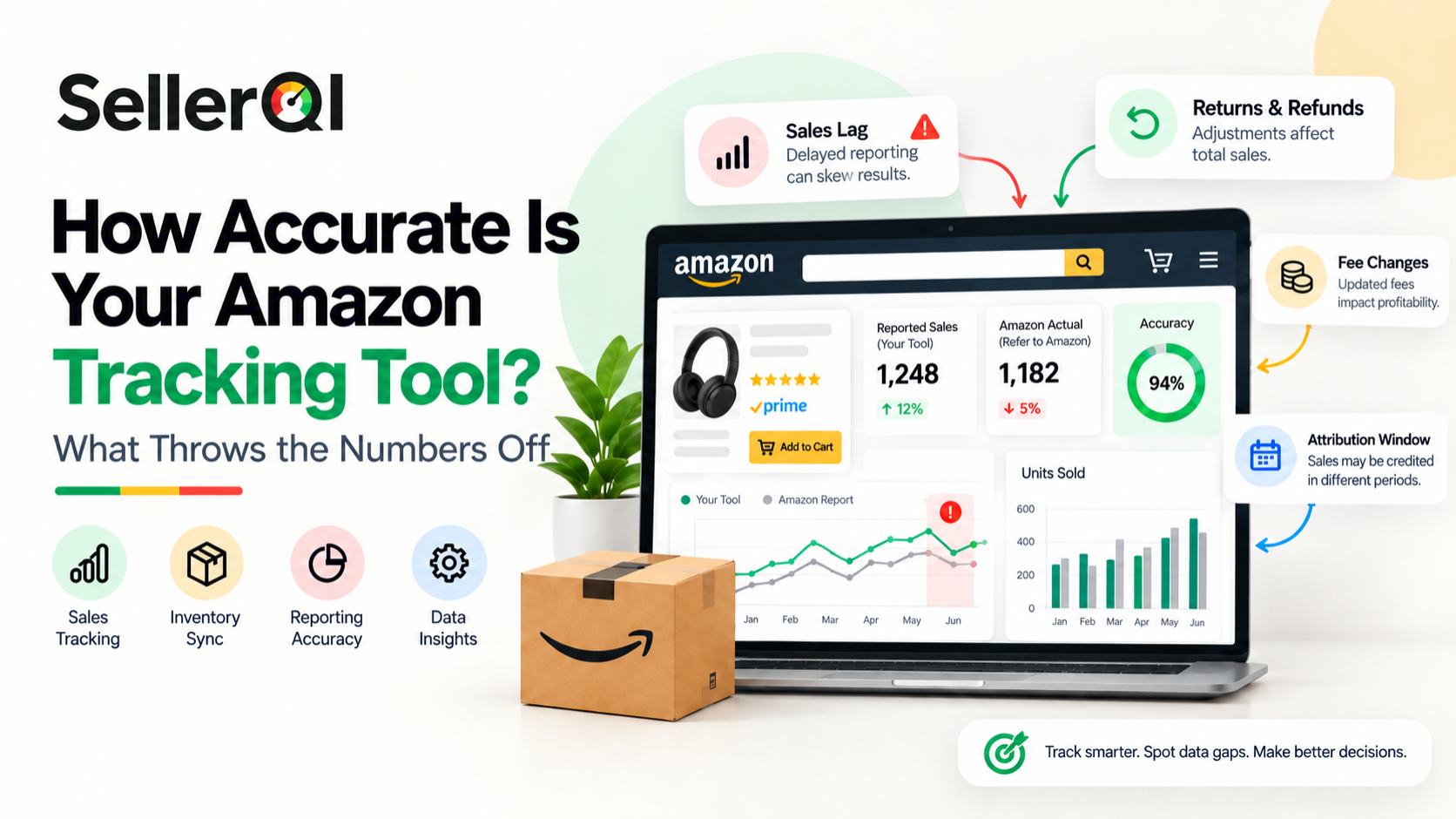
An Amazon keyword tracking tool estimates where a product ranks for specific search terms on Amazon, but its reported position may differ from what shoppers actually see. Marketplace selection, search personalization, tracking frequency, keyword variations, and data collection methods can all affect accuracy. To trust your rankings, compare consistent measurements and distinguish genuine ranking changes from tracking noise. Amazon seller reports also play an important role.
What is an Amazon keyword tracking tool?
An Amazon keyword tracking tool monitors a product's position in Amazon search results for selected keywords over time. It helps sellers understand search visibility, identify ranking changes, compare keyword performance, and evaluate whether listing optimization efforts are producing measurable results.
Depending on the software, tracking may include:
- Organic keyword positions
- Sponsored placement monitoring
- Historical ranking changes
- Competitor keyword positions
- Keyword ranking reports
- Scheduled updates and alerts
- Marketplace-specific tracking
However, a tracking tool does not necessarily show the exact results every shopper sees. Its reported position depends on how, where, and when the data is collected.
Why is your Amazon keyword tracking tool showing different rankings?
An Amazon keyword tracking tool can show different rankings because Amazon search results are dynamic and the tool may collect data under different conditions. Even when your listing has not changed, differences in marketplace, search location, device, query format, and collection time can affect the reported position.
1. Marketplace differences
Amazon US, UK, Australia, and other marketplaces have different search results, competitors, and product availability. A keyword ranking recorded on Amazon.com cannot automatically represent your position on Amazon.co.uk or Amazon.com.au.
What to check: Confirm that the tool tracks the same marketplace you are evaluating in Seller Central or through manual searches.
2. Search personalization and location
Search results may vary depending on shopper context, location, delivery availability, and other signals. A tracking tool may use a standardized search environment that differs from an individual shopper's experience.
What to check: Use consistent tracking settings and avoid treating one personal search as the definitive ranking for every customer.
3. Tracking frequency and timing
Amazon rankings can change throughout the day as competing offers, availability, and search results change. A tool that checks once daily may capture a different position from one that checks several times.
What to check: Compare measurements taken at similar times and review trends rather than reacting to every temporary fluctuation.
4. Keyword variations
Small changes in a query can produce different results. For example, "wireless mouse" and "wireless gaming mouse" may have different competitive landscapes and ranking positions.
What to check: Track the exact search phrase you intend to evaluate. Do not combine variations into one ranking measurement.
5. Organic versus sponsored placements
Sponsored ads can appear above organic search results. Some tools report organic ranking separately, while others may display paid placement data alongside organic results.
What to check: Confirm whether the reported position is organic, sponsored, or a combined visibility metric.
6. Tracking methodology and data delays
Tools may differ in how they collect search results, process pages, identify products, and refresh historical data. Temporary data delays or incomplete result collection can also create discrepancies.
What to check: Review the tool's update frequency, tracking methodology, and product-identification process before comparing its numbers with another platform.
What is Amazon keyword position tracking?
Amazon keyword position tracking measures where a product appears in search results for a specific keyword at a particular time. Repeated measurements help sellers understand whether a product is gaining visibility, losing position, or remaining relatively stable.
For example, if a product moves from position 18 to position 11 for a target keyword, its measured organic position has improved. However, that movement does not automatically mean sales or conversions have increased.
Sellers should evaluate keyword position alongside other metrics, such as:
- Search impressions
- Click-through rate
- Sessions
- Conversion rate
- Organic sales
- Advertising performance
This broader view helps distinguish a ranking improvement from a commercially meaningful improvement.
Amazon rank tracking software with alerts and reports
Amazon rank tracking software with alerts and reports is software that monitors product rankings for selected keywords, stores historical position data, and notifies sellers about specified ranking changes or other tracked conditions.
Features to look for
- Scheduled keyword tracking: Checks rankings at defined intervals.
- Ranking alerts: Notifies users when a keyword moves beyond a configured threshold.
- Historical data: Records ranking changes over time.
- Keyword ranking reports: Summarizes current positions and historical trends.
- Competitor tracking: Compares your product's position with competing ASINs.
- Marketplace selection: Tracks rankings in the intended Amazon marketplace.
- Organic and sponsored separation: Makes it clear which type of placement is being measured.
- Export options: Allows teams to share reports and analyze historical performance.
Before choosing software, check whether alerts reflect actual search-position changes or broader visibility estimates. An alert is only as useful as the underlying data and the threshold used to trigger it.
Which Amazon keyword tracking tool is most accurate?
The most accurate Amazon keyword tracking tool is the one that consistently measures the correct ASIN, exact keyword, marketplace, and placement using a transparent and repeatable methodology. No tool can guarantee that its reported position will match every shopper's live search results. Compare tools using the same test conditions rather than relying on marketing claims.
Ranked evaluation criteria for tracking accuracy
- Consistent marketplace and query settings: The tool tracks the intended Amazon marketplace and exact search phrase, reducing avoidable measurement differences.
- Clear organic and sponsored reporting: Separating paid placements from organic rankings prevents misleading position comparisons.
- Reliable product identification: The tool consistently identifies the correct ASIN in the collected search results.
- Transparent update frequency: You know when the ranking was checked and how fresh the reported data is.
- Historical records and repeatability: You can compare results over time and investigate whether unusual movements persist.
These are ranked evaluation criteria, not a claim that one vendor has been proven more accurate than every competitor. To identify the best option for your business, test several tools against the same keywords and ASINs.
How to test whether your Amazon keyword ranking tracker is accurate?
You can evaluate an Amazon keyword ranking tracker by comparing its reports with repeated manual checks under consistent conditions. The goal is to identify persistent discrepancies rather than expect every measurement to match perfectly.
Step 1: Select representative keywords
Choose 10–20 keywords that cover different search intents, including your main product terms, long-tail phrases, and important high-competition queries.
Step 2: Record the correct ASIN and marketplace
Make sure the tool is monitoring the same product and marketplace you use for your manual comparison.
Step 3: Check rankings at similar times
Record manual search results close to the tool's tracking time. Keep the marketplace, query, and search conditions as consistent as possible.
Step 4: Separate organic and sponsored positions
Record the organic position independently from paid placements. Otherwise, you may compare two different measurements.
Step 5: Repeat the test
Repeat checks across several days. A persistent difference is more useful evidence than a single mismatch during a changing search session.
Step 6: Investigate recurring discrepancies
If differences continue, check the tool's tracking frequency, result depth, marketplace configuration, ASIN matching, and treatment of sponsored results.
What is an Amazon keyword ranking report?
An Amazon keyword ranking report summarizes how a product performs in Amazon search for selected keywords over a defined period. Depending on the tool, it may include current positions, historical movements, competitor rankings, search visibility, and alerts.
A useful report should make it easy to answer three questions:
- Which keywords are improving or declining?
- Are changes sustained or temporary?
- Do ranking movements correspond with changes in impressions, traffic, or sales?
How to read a keyword ranking report correctly
| Report element | What it tells you | What it does not prove |
|---|---|---|
| Current position | Recorded position at the latest check | The exact position every shopper sees |
| Position change | Difference between measurements | That an optimization caused the change |
| Historical trend | Direction of ranking over time | That sales will increase |
| Competitor position | Recorded competitor visibility | That the competitor is winning more sales |
| Ranking alert | A threshold or condition has been triggered | That the change is permanent |
| Organic visibility | Presence in organic search results | Total impressions or conversion rate |
Use ranking reports as diagnostic evidence, not as a substitute for business-performance data.
How does SellerQI Amazon keyword tracking help sellers?
SellerQI Amazon keyword tracking is relevant for sellers who want to understand keyword visibility alongside broader listing diagnostics. SellerQI's platform focuses on identifying Amazon listing and account issues, including missing keywords, indexing errors, suppressed listings, and other problems that may affect discoverability.
This is an important distinction: keyword tracking tells you where a product is appearing, while listing diagnostics can help explain why visibility may be limited.
A practical workflow combines both:
- Track priority keywords and identify changes in visibility.
- Check whether the target product is indexed for relevant search terms.
- Investigate listing health, missing keywords, and other potential issues.
- Correct verified problems rather than making random listing edits.
- Monitor subsequent ranking and business-performance changes.
Why does Amazon keyword ranking change even when you make no listing edits?
Amazon keyword rankings can change without listing edits because competing sellers may adjust their offers, products may become unavailable, customer demand may shift, and Amazon's search results may change.
Other possible factors include changes in advertising activity, sales performance, query relevance, and the tracking conditions used to measure position.
If a keyword drops suddenly, follow this sequence:
- Confirm the ranking change with a repeat measurement.
- Check whether the product remains indexed for the keyword.
- Review inventory, price, offer availability, and listing status.
- Compare competitor visibility and relevant performance metrics.
- Check whether the movement persists before changing listing content.
This prevents sellers from rewriting a listing in response to a short-lived or measurement-related fluctuation. QMate for Amazon sellers can also help you decide what to do next.
Frequently asked questions
What should I look for in an Amazon keyword tracking tool?
An Amazon keyword tracking tool should provide consistent marketplace-specific tracking, exact keyword monitoring, historical ranking data, clear organic and sponsored reporting, and reliable ASIN identification. Alerts and exportable reports are useful additions when they support your day-to-day workflow.
Why is my Amazon keyword position tracking different from my manual search?
Amazon keyword position tracking may differ from manual results because of search context, location, timing, sponsored placements, or differences in how the tool collects search results. Compare the same ASIN and query under similar conditions before concluding that the tool is inaccurate.
How can I verify an Amazon keyword ranking tracker before paying for it?
Test an Amazon keyword ranking tracker with a sample of important keywords and ASINs. Compare its reported positions with repeated manual checks, verify marketplace settings, and confirm that organic rankings are separated from sponsored placements.
What should an Amazon keyword ranking report include?
An Amazon keyword ranking report should include the keyword, ASIN, marketplace, recorded position, date of measurement, and historical movement. Competitor comparisons and alerts can add value, provided the report explains what each metric measures.
Does SellerQI Amazon keyword tracking identify indexing problems?
SellerQI Amazon keyword tracking should be considered alongside listing diagnostics rather than assumed to be a standalone rank-tracking feature. SellerQI's listing health capabilities identify issues such as missing keywords and indexing errors, which can help sellers investigate limited search visibility.
Can an Amazon keyword tracking tool guarantee accurate rankings?
No Amazon keyword tracking tool can guarantee an exact position for every shopper because search results can vary and tracking methods differ. A reliable tool should provide consistent measurements, transparent settings, and historical data that help you understand ranking trends.
How do I choose Amazon rank tracking software with alerts and reports?
Choose Amazon rank tracking software with alerts and reports that supports your marketplace, tracks the correct ASIN, separates organic and sponsored placements, and lets you configure meaningful ranking thresholds. Check update frequency, historical data availability, and reporting limits before subscribing.