Amazon Business
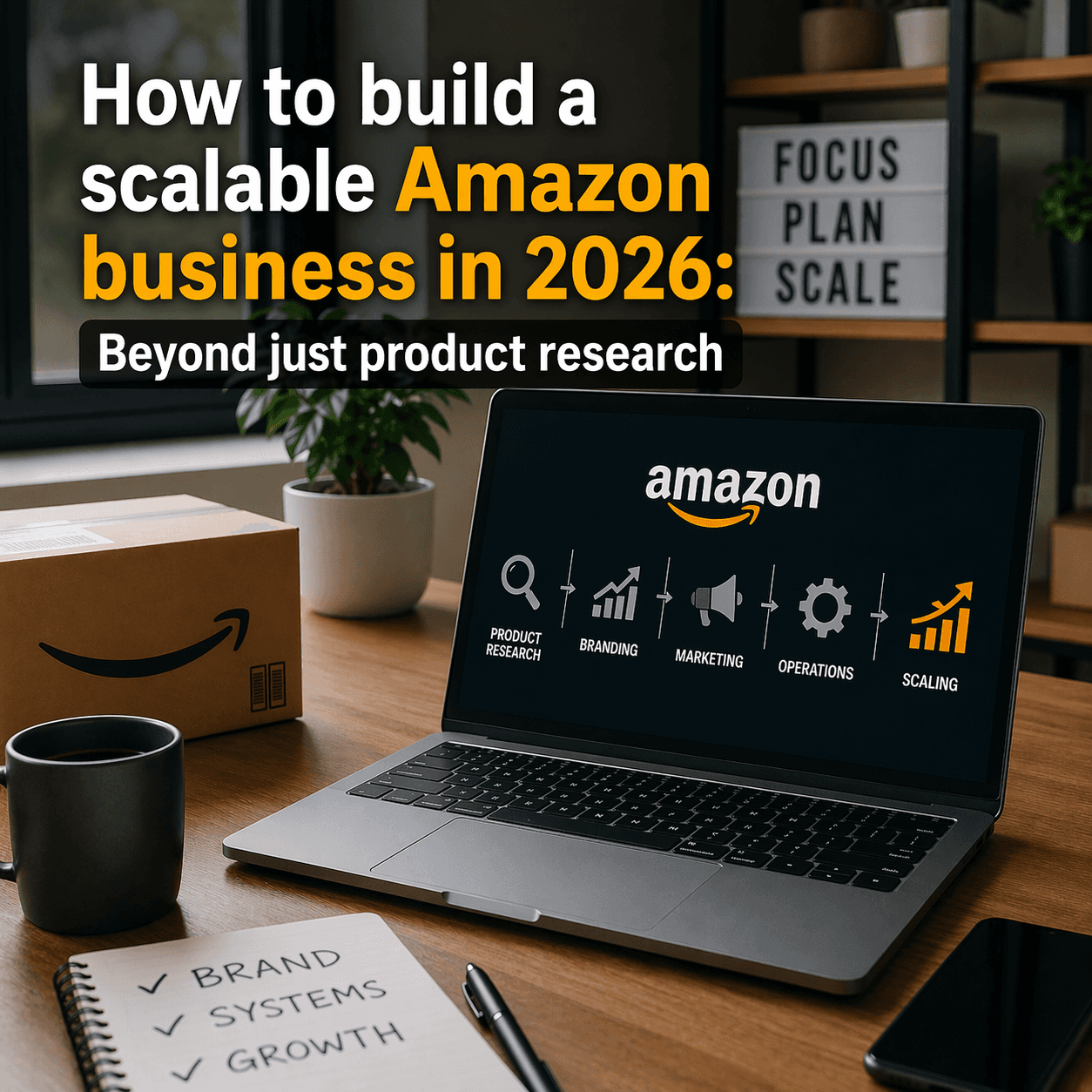
How to build a scalable Amazon business in 2026: Beyond just product research

Jimi Patel
10 min read
TL;DR
Most Amazon sellers plateau not because of product issues, but due to a lack of operational visibility.
Scaling requires tracking listing health, ad performance, profitability, and reimbursements in real time.
Hidden issues like indexing errors, wasted ad spend, and missed reimbursements silently reduce growth.
Increasing ad spend without fixing inefficiencies leads to higher costs, not better results.
ASIN-level profit tracking is essential to know what to scale and what to cut.
Systems and tools that centralise data and tasks help sellers scale faster and make better decisions.
Most Amazon sellers hit a wall somewhere between $10k and $50k a month and can't figure out why. The product is solid. Reviews are decent. Ads are running. But growth has stalled, and every attempt to push through it just burns more budget without moving the needle.
But it's an operational visibility problem. In 2026, the sellers who break through it aren't the ones who found a better product or a lower-competition niche. They're the ones who built systems that show them exactly what's happening inside their business and act on it fast.
This blog breaks down the real reasons Amazon sellers plateau, why the standard "scale your ads and add more SKUs" advice keeps failing people, and what building a genuinely scalable Amazon business actually looks like when you're using real data.
Why does Amazon product research stop being the main problem once you start scaling?
Product research gets all the attention in the Amazon seller community, and for good reason. But once you're past launch, product research is maybe 20% of what determines whether your business scales or stalls.
The other 80% is operational. It's what happens after the product goes live. Two sellers launch the same product in the same niche. Same keyword strategy, similar budgets. Six months later, one is at $40k a month and climbing. The other is stuck at $12k, running the same campaigns, wondering what went wrong.
The difference rarely comes down to the product. It comes down to how quickly each seller spots problems and fixes them: listing errors that suppress discoverability, ad spend flowing into search terms that never convert, profit margins eroded by FBA fees they didn't track closely enough, and reimbursements they never claimed.
These aren't dramatic failures. They're quiet, invisible ones. And in 2026, with Amazon's automated enforcement tighter than ever and fees consuming 45 to 55% of revenue for many sellers, quiet failures compound fast.
Are your listings actually working?
This is one of the most uncomfortable questions for a scaling seller to sit with. Your listing is live. Traffic is coming in. Sales are happening.
So it must be fine, right? Not necessarily.
Listings can be live and broken at the same time. Indexing errors mean Amazon's algorithm isn't connecting your product to the search terms you're targeting, so you're invisible to a chunk of your potential buyers without knowing it.
Blocked keywords sit silently in your backend, doing nothing. Missing attributes push your listing down in filtered search results. Image compliance gaps can trigger suppression at any time. None of these issues announce itself.
Your sales don't suddenly drop off a cliff; they just quietly underperform against what they should be doing. And if you're making scaling decisions (more ad spend, new product launches, marketplace expansion) based on a listing that's secretly underperforming, you're building on a cracked foundation.
This is exactly why a “Listing Health Scanner” changes how serious sellers operate. Rather than manually auditing listings one by one or worse, not auditing them at all, it surfaces every issue instantly: missing keywords, blocked terms, indexing failures, image gaps, and SEO problems.
Is your PPC spent growing your business?
Scaling ad spend is not the same as scaling your business. But it's easy to confuse the two, especially when revenue is going up at the same time costs are going up.
Here's the problem most sellers face as they grow: the same structural inefficiencies that existed in their campaigns at $5k/month in ad spend still exist at $20k/month. Zero-sale search terms keep running. Broad match terms attract irrelevant traffic.
The budget gets pulled toward campaigns that drive clicks but not conversions. At a small scale, this waste is annoying but manageable. At a larger scale, it's genuinely dangerous to your margins. The bigger your budget gets, the harder it becomes to manually spot where the leaks are. Two things fix this properly.
A sponsored ads cost saver that identifies and eliminates zero-sale search terms fast, so your budget stops funding failure automatically.
A high-value keyword finder that uses real performance data to surface the search terms that do convert, so you can push budget towards what's actually working and add winning terms directly into your manual campaigns.
The goal isn't just to reduce waste; it's to redirect that reclaimed budget into terms with a proven track record. That's how ad spend starts compounding instead of just accumulating.
Do you know which of your ASINs are actually profitable?
Most Amazon sellers think they know their margins. Ask them what their net profit is on their best-selling ASIN after FBA fees, ad spend, returns, storage costs, and refunds, and the honest answer is often: "roughly" or "I think around 20%."
"Roughly" is fine when you're at three products and low volume. It's a serious problem when you're scaling. Because without clean per-ASIN profitability data, you can't answer the most important questions in your business:
Which products should I be scaling?
Which ones are quietly losing money at high volume?
Where should I cut spending, and where should I double down?
An ASIN-level profit dashboard takes this from guesswork to clarity. Every ASIN, every cost layer, clean and real-time, without building complicated spreadsheets or manually pulling reports from Seller Central. When you can see exactly which ASINs are your real profit drivers versus which ones just look good on revenue, your scaling decisions get sharper immediately.
How do you keep everything moving without losing track?
The bigger your Amazon business gets, the more moving parts you're managing simultaneously. Listing issues to fix, keywords to add, campaigns to adjust, compliance flags to resolve, reimbursement claims to submit.
Without a clear system, important tasks fall through the cracks and on Amazon, dropped tasks become dropped rankings. An Amazon task list manager that organises every listing issue, keyword gap, violation, and fix into a single prioritised workflow keeps your account health strong without requiring you to hold everything in your head or across multiple spreadsheets.
Conclusion
Building a scalable Amazon business in 2026 doesn't start with finding the next winning product. It starts with getting complete visibility into what your current business is actually doing, where money is being lost, where listings are underperforming, where ads are failing, and where profit is hiding.
The sellers who scale consistently aren't necessarily smarter or luckier. They're just operating with better information, faster. They catch listing errors in hours instead of weeks. They redirect wasted ad spend before it compounds. They know exactly which ASINs to push and which to cut.
SellerQI is built for serious Amazon sellers with the visibility and tools to run their business on data, not assumptions. If you're ready to move beyond guesswork and start scaling with clarity, it's worth seeing what you've been missing.
FAQs
How do I find out if my Amazon listings have indexing errors?
Your listing appears completely normal while Amazon silently stops connecting it to your target search terms. A dedicated listing health tool is the only way to catch blocked terms, missing attributes, and SEO gaps before they keep costing you rankings.
How much money do Amazon sellers lose to unclaimed reimbursements?
FBA sellers regularly have hundreds to thousands of dollars in unclaimed reimbursements sitting idle from lost inventory, wrong returns, and fee errors Amazon never flags. If you're not actively tracking and submitting claims, that money is simply gone.
How do I know which Amazon products to scale and which to cut?
A product doing strong revenue can still be losing money once FBA fees, ad spend, storage, and returns are all subtracted and revenue numbers alone will never show you that. Clean per-ASIN profit data is the only way to make scaling decisions you can actually trust.