Amazon FBA Management
How to create high-converting Amazon listings in 2026

Jimi Patel
10 min read
TL;DR
Amazon listings in 2026 must optimize for both ranking and conversion, focusing on CTR, consistent sales, and clear shopper communication rather than just keyword stuffing.
High-converting listings combine strong titles, high-quality images, benefit-driven bullet points, backend keywords, and A+ Content working together as a system.
Amazon’s A10 algorithm and AI tools like Rufus prioritize listings that answer user intent, provide complete information, and maintain compliance with platform policies.
Backend issues like indexing errors, blocked terms, and compliance violations can silently hurt visibility, making regular audits essential.
Best practices include front-loading primary keywords, using all bullet points strategically, maximizing backend keyword space, and investing in Premium A+ Content.
AI-powered tools like SellerQI help automate listing audits, identify gaps instantly, and improve optimization efficiency, reducing manual effort and increasing sales potential.
Selling on Amazon in 2026 is not just about having a great product; it's about having a listing that actually works. With over 9.7 million sellers competing for the same customers, a poorly optimized listing means lost clicks, lost conversions, and lost revenue.
Amazon's algorithm has grown smarter, shoppers have grown pickier, and AI tools like Amazon Rufus are changing how products get discovered. If your listing isn't dialed in right now, you're leaving money on the table every single day. This guide breaks down exactly how to create high-converting Amazon listings in 2026, step by step.
How to optimize Amazon product listings for higher conversions?
Let's start with the basics: what does it actually mean to optimize a listing?
It means making sure your product title, images, bullet points, description, and backend keywords are all working together, not just to rank in search, but to convince the shopper to buy once they land on your page. In 2026, Amazon's A10 algorithm looks at more than keywords. It rewards listings that:
Drive high click-through rates (CTR) from search results
Convert visitors into buyers consistently
Answer shopper questions clearly and quickly
Stay compliant with Amazon's content policies
The sellers who are dominating page one right now aren't keyword stuffing. They're building listings that match what shoppers are actually looking for and then making it ridiculously easy for those shoppers to say yes.
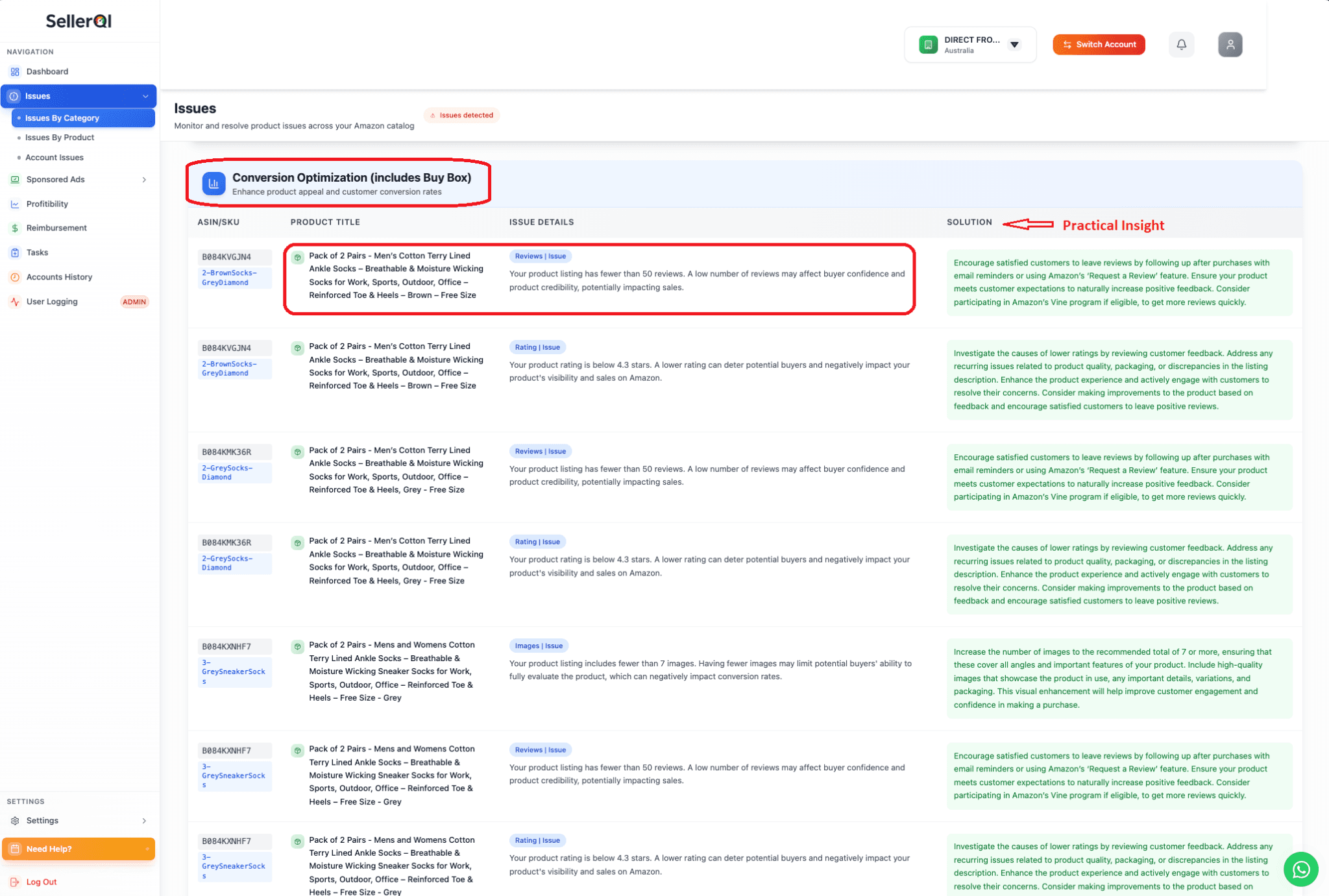
One thing many sellers overlook? Indexing errors and blocked terms that quietly kill visibility. Your listing can look perfect on the surface and still not be ranking because of a backend issue you can't see.
This is exactly where SellerQI's listing health scanner becomes a game-changer; it identifies missing keywords, blocked terms, indexing errors, image gaps, and SEO issues instantly, so nothing is silently costing you sales.
Best practices for Amazon product listing optimization in 2026
Here are the practices that are actually moving the needle this year:
Front-load your most important keyword in the title: Amazon truncates titles on mobile at around 80 characters. That means your primary keyword, like "Amazon product listing optimization", must appear in the first 80 characters. Most shoppers are on mobile. If your keyword isn't visible, your CTR suffers.
Use all five bullet points strategically: Each bullet should lead with a capitalized benefit, not a feature. Don't just say "stainless steel body", say "BUILT TO LAST. Premium 18/8 stainless steel resists rust and handles daily use for 10+ years." Specifics build trust. Trust drives conversions.
Invest in Premium A+ Content: Brands using Premium A+ Content are reporting up to 20% higher conversion rates compared to basic listings. In 2026, A+ Content isn't optional for competitive categories. Use it to tell your brand story, answer common questions, and include comparison tables.
Treat backend search terms as prime real estate: You have approximately 250 bytes of backend space. Use every single byte. Include synonyms, misspellings, and Spanish-language terms for the US market. Do not repeat keywords already in your title; it wastes space and adds zero SEO value.
Keep listings compliant and healthy: Amazon is aggressively enforcing content policies in 2026. Listings with promotional language in titles ("Best Seller," "#1 Rated") are being suppressed automatically. Compliance issues don't just hurt rankings; they can shut your listing down entirely.
Running regular audits manually takes hours. SellerQI's Listing Health Scanner does it instantly scanning every ASIN for SEO gaps, compliance issues, and image problems, and surfacing exactly what needs to be fixed.
How to write Amazon product titles and descriptions that sell?
Your title and description are your two biggest conversion levers. Here's how to write them for 2026:
The winning title formula:
Brand Name + Primary Keyword + Key Attribute + Size/Quantity + Differentiator
For bullet points and descriptions, follow what sellers call the "answer first" approach. Shoppers skim. They're not reading paragraphs; they're scanning for the answer to one question: "Does this solve my problem?" Get to that answer in the first line of every bullet.
In 2026, Amazon's AI assistant Rufus reads your listing copy and Q&A section to answer shopper questions in real time. That means your description needs to sound conversational and cover real use-case scenarios, not just dry specs.
Think: who is buying this, why are they buying it, and what question are they asking before they hit "Add to Cart"?
Also, never underestimate the description's role in keyword indexing. While Amazon officially says the product description isn't a major ranking factor, it is indexed, and it gives Rufus additional context to surface your product for relevant queries.
Amazon listing optimization checklist for better ranking
Section | Checklist Item |
Title | Primary keyword in first 80 characters |
Under 200 characters total | |
No promotional language (“Best,” “Free Shipping,” “#1”) | |
Reads naturally | |
Images | Main image: white background, product fills 85%+ of frame |
Minimum resolution: 2000 × 2000 px for zoom | |
All 9 image slots used | |
At least one lifestyle image and one infographic callout | |
Bullet Points | 5 bullets used |
Each starts with a capitalized benefit headline | |
Specific numbers, materials, or data included | |
Covers top shopper objections | |
Backend Keywords | All 250 bytes used |
No repetition from title or bullets | |
Synonyms and misspellings included | |
A+ Content | Published and indexed |
Includes FAQ module | |
Includes comparison or feature module | |
Listing Health | No suppression warnings in Seller Central |
No blocked terms or indexing errors | |
All compliance fields completed |
The last point is where most sellers fall short, because compliance and indexing issues are invisible unless you're actively looking for them. SellerQI's Listing Health Scanner flags every one of these automatically, turning what used to be a manual 2-hour audit into a 2-minute fix.
Conclusion
Amazon listing optimization in 2026 is a full system, not a one-time task. Your title, images, bullets, backend keywords, and listing health all work together to rank and convert. Get one thing wrong, and the whole engine slows down.
You don't have to do it all manually. SellerQI's listing health scanner gives you instant visibility into exactly what's broken, missing keywords, indexing errors, image gaps, SEO issues, so you can fix what matters and grow faster. Stop guessing. Start selling smarter.
FAQs
Does A+ Content really improve Amazon conversion rates?
Yes. Premium A+ Content drives up to 20% higher conversions by giving shoppers richer visuals, clearer answers, and stronger brand trust. If you're brand registered and skipping A+, you're leaving real money on the table.
How do I find the best keywords for my Amazon listing in 2026?
Use seed keywords, competitor reverse ASIN research, and long-tail buying-intent terms that convert 2 to 3x better than generic ones. SellerQI's High-Value Keyword Finder pulls this from real performance data, so you're always working with what actually sells.
How do I optimize my Amazon listing for Rufus AI?
Write your bullets, A+ Content, and Q&A in a conversational, question-answering format that covers real use cases and objections. Rufus reads all of it. The more complete your listing, the more likely it is to get recommended.
How do I get more reviews on Amazon to boost my listing?
Ship a product that works as described, use Amazon Vine for new launches, and keep your Q&A section fully answered. Reviews are both a conversion signal and a Rufus AI ranking factor in 2026; don't ignore them.